March is an awkward month of the year in this country. It is when the "cold" easterlies stop and replaced by the hot winds. Literally, the air suddenly gets hot, it didn't even pass by warm! Temperatures will now all be above 31C which will still go up to about 37 or 38C. The other night i suddenly woke up feeling the perspiration on my head and neck. It is the start of the dry-hot season, the difficulty going outside the building, the plants drying up, and the soaring of electric bills from continuous airconditioning units.
AT least we still have lots of flowers. Of course, we actually don't loose the flowers, but many of what we have now will also die the following months.
I would like to show you my flowers grouped into colors.
REDS
Above and below: Episcia
a rose bud
milkweed, Asclepias curassavica
I am very much fascinated by those ladylike structures of the flowers with their flowing red gowns. But this milkweed is not commonly growing in our lowlands. In fact this is growing with me for the first time, flowering for the first time, which excites me a lot. I got the seeds from the cold uplands before Christmas. I know this is the host for the monarch and we also have a Philippine monarch species, so i am hoping they will eventually find their way to my milkweed. If the monarchs in Mexico can travel the distance to the US, then i am hoping wherever our native monarchs are will finally show up to eat my milkweeds. Let us see, i am hoping!
It is amazing that there are stages in maturity showing at the same time in one plant. Despite my going home only on some weekends, at least i will always see them at the open stages. They are so lovely.
The plants are not as tall as those in the cold uplands in Baguio City, but they also grow luxuriously and looking healthy in my garden. I just realized they mature fast in hotter climes. Nothing is eating its leaves yet. The monarchs are nowhere to be seen.
WHITES
Clitoria ternatea
I planted the seeds of this, thinking i am planting the common blue butterfly pea. Only 1 plant germinated, and eventually a white flower emerges instead of the blue. It could be disappointing, but it actually is beautiful that also fascinates me. Although of course, i will not be able to produce blue rice, and blue juices. Nevertheless, i love the white one.
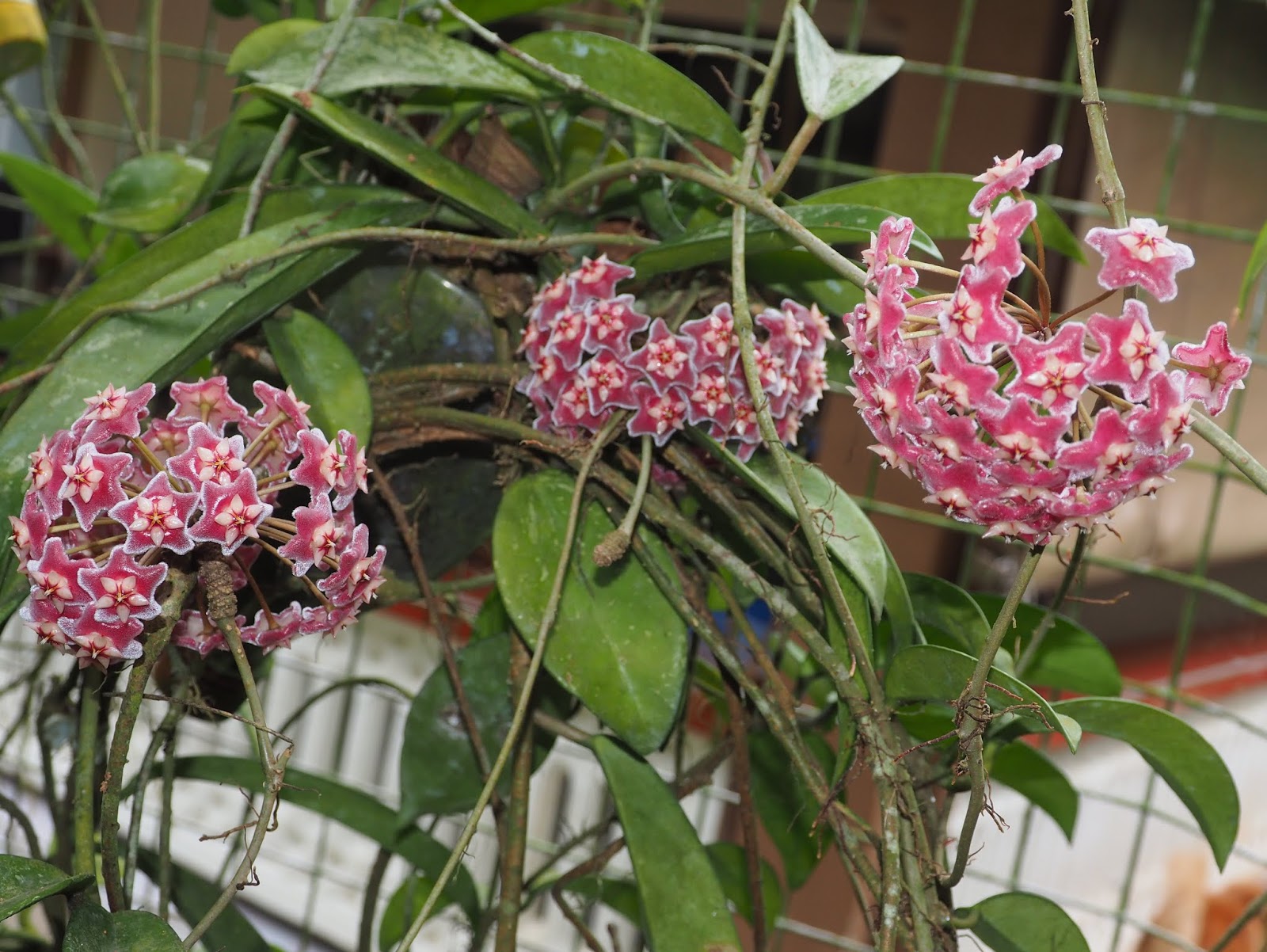
Hoya multiflora
My bloom day will not be complete if i will not be including some hoyas. There are always a few of them blooming in my garden.They sustain my lust for flowers every weekend when i go home. They say "food satisfies the body, but flowers sooth the soul". Nothing is more apt than that.
Hoya celata
Not many hoya species are white. There are a few more but mine is not yet flowering, except for this Hoya celata.
VIOLETS
I realized i have more violets blooming now. I wonder why they suddenly opened at the same time to make me have some conclusions about them. That i have actually lots of violet flowers in my garden. I didn't intend to have all those, but they are already there, so get the most out of them.
Hoya pubicorolla ssp. anthracina
This started as black or almost black, in fact, its original commercial name is Hoya pubicalyx 'Black Dragon'. But hoya flowers being mostly anthocyanins change color with different conditions. This is one of them that responds well with changes in the environment including its media.
Hoya pubicalyx
This is one of the remnants of the orchids i once owned. They were neglected, and just left on their own 'instinct' to live, to perpetuate the species. They are watered only by the rain and not fertilized at all in their lifetime. I guess it just got to become tolerant or resistant of the unwelcome conditions in my garden. Definitely, an orchid is always loved when it suddenly showed up.
Duranta erecta, is one of the most durable plants in my garden. It gets stressed and yellow during the very hot dry season, but it never fails to show some flowers. I planted it for the butterflies, and it never disappoints.
a single flower of Impatiens balsamina,
If i didn't take a picture of a single flower, i wouldn't realize it is very beautiful and elegant. They grow in droves, get a bit invasive and thrive so fast so easily. That is the reason i fail to see it like above.
The single plant
The above group is not planted intentionally. They are the seeds from the previous growths and suddenly emerged that plenty. The original has peach, purple, whites, but the peach didn't show up in this generation and only a few white plants are growing.
GREENS
anthurium
You might think that there is no green flower, sometimes there are! This is actually a pink anthurium. I intentionally touched that spadix when the minute flowers are still open, trying to pollinate them. A few of those bulges in the spadix are the anthurium seeds, which are more plenty at the base. I learned that the upper portion is the male part, however there are also a few bulges there, which means some seeds are developing there too. Anthurium seeds mature in almost a year, so if i will really be interested to get those seeds i need to wait for a lot more months. However, i will not wait for that, as i am not really getting the seeds from its selfing. My curiosity just got the better of me during that time, just needed to see some green anthurium spadix.