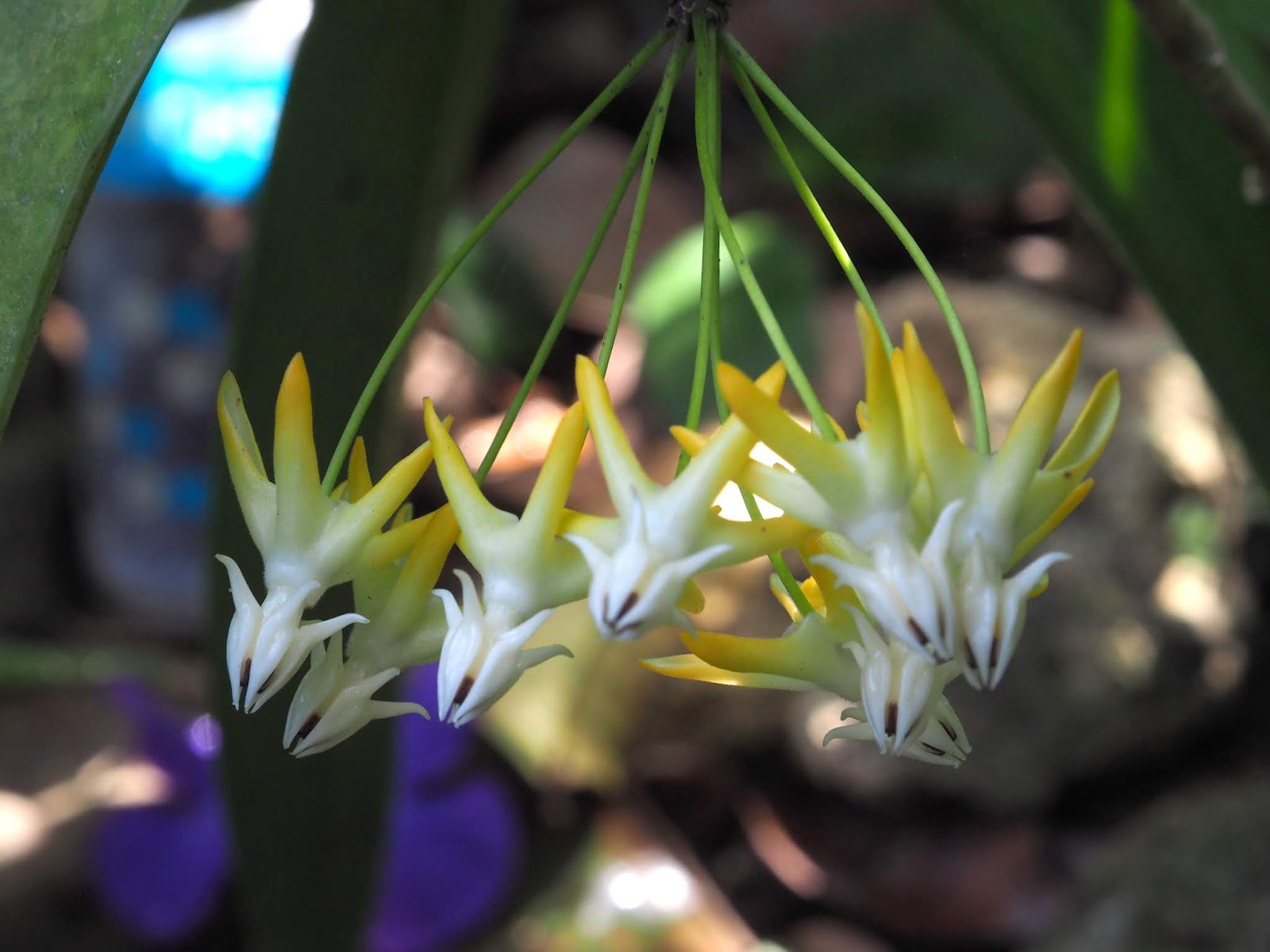
Showing posts with label Hoya celata. Show all posts

Sunday, September 16, 2018

Blooms in Rainy September


 August/September is the height of our rainy months. Our Rainy Season is also the typhoon months, when the letters of the alphabet are not enough to name them. We repeat the alphabet letters when approaching the end of the year. Last July we already finished 10 letters for the typhoons that passed our Philippine Area of Responsibility. At the moment there is a looming Super Typhoon with the strength of Yolanda looming at the Pacific Ocean. It is said to be at our Philippine Area of Responsibility thip afternoon. Those in Northern Philippines are already preparing, classes are already suspended there, but still we are praying for it to divert its path away from our PAR!

Low Pressure Areas (LPA) are common with us. These LPAs strongly attracts the Southwest Monsoon rains that eventually got many areas to flooding situations. Until now there still are flooded low-lying areas even if the rains happened weeks ago. It is a big problem for health and sanitation. Fortunately, our area in the province is in the uplands, and my area in the city is the same as well. At least going home from the office is not at bad as others experience, as in going through floodied streets. '

Plants in the province are now luxuriously growing, blooming as much as they can to produce seeds before the dry season comes again.

 One of the lilies that started blooming in July still has some scapes till now. This Crinum zeylanicum gives a strongly sweet scent that serves as air freshener near the gate.

The hoyas are confined in an enclosure near the terrace, and early afternoons are laden with scents that nobody will ignore. Even just an opening umbel from one plant will already get your attention. Imagine the fragrance from the lots of umbels of different species in my garden! A visitor will just say OMG or Whew! A scent will prod a visitor to locate where that is coming from, and they will learn the characteristics of that hoya! Sometimes they really get hooked! HUH.

 Hoya celata (formerly called Hoya pubicalyx White Dragon) is a prolific bloomer whenever it starts blooming. New buds immediately develop as the previous buds drop. 

 Another form of Hoya pubicalyx but is not as famous as the common one. This has longer internodes and roundish, clear green leaves. The chimera flowers look like that of the 'Royal Hawaiian Purple', but the umbels are bigger. It now has 4 umbels at different stages of maturity.

 Hoya buotii (purple) is also a floriferous species. A bigger plant produces a lot of umbels that bloom at almost the same time making a wonderful sight. Once-in-a while it produces some flowers with 6 corollas, and that makes us hoya hobbyists very glad. Can you see it at the rightmost side?

 Hoya mariae grows profusely with vines facing everywhere, that you need immediate attention. A week you forgot to guide the shoots and you will end up with a very difficult situation, it will deliberately embrace a nearby stem to cling on. Removing twining stems often break the younger portions that earlier attention to unwind them will be better.

 Hoya buotii (yellow) 

Hoya multiflora is known for its floriferousness, sometimes with an umbel in every node. However, mine is not growing nicely and suffered much during last dry season. It needs a good Relative Humidity in the surrounding air to grow healthily.

 Hoya ilagiorum, also flowers consecutively after every flower drop, but vegetative growth is not as fast as other species. My plant is a bit lanky with lesser leaves.

This Hoya pubicorolla ssp. anthracina is producing a few umbels, and they are all big and beautiful. Can you visualize it. 

 Hoya lacunosa is one of the small-umbelled hoyas, with also small leaves. But the size is compensated with the very lovely sweet scent, which everybody likes.  Sometimes it has a lot of simultaneous umbels open at the same time. 

Please bear with me in posting a lot of hoyas, i am a hoya addict, i confess! I always tell new hobbyists that it is addictive and contagious, so they must decide immediately before they are hooked. They are what use most of my time in the province during my weekends, the reason i always go home on Saturdays. I am sure you will understand. And i also warn you, if you are just starting to appreciate them, or starting to buy the first one! 

The most loyal orchid in my garden, despite neglect it still produce flowers looking very elegant and standing high among the rest of them, a Vanda orchid. It really is the Queen of the Flowering Plants!

And another loyal and self-supporting orchid with very subtle, cool color is this vanda.

 A lavender Pentas lanceolata is much loved by this Common Mormon. We have lots of butterflies, but this one never forgets to visit this pentas. 

 Another nectar plant in my garden is this Ixora javanica. It actually becomes a tall bush, like a small tree. It suffered setback because the original tree was killed to give way to the garage. This new plant is just starting, but already giving the characteristically very big umbels, also loved by butterflies.

 an introduced species, now relegated near the dump

Caladiums respond favorably to the wet environment. I already took the picture as more leaves enlarge because in a little while the hawkmoths will fully devour their leaves.

 This caladium variety is lovely too in that area with very thin topsoil. It covers the not so nice area there. I planted it there specifically because they produced so very big aand tall leaves when planted in richer soils. In this area they are shorter and narrower, producing more compact growth.

 Look at the caladium when planted in rich soil. That big leaf at the left is more than 2 ft wide. Other leaves are following that size. Eventually i will get some corms and plant them too in nutrient deprived soils to produce more compact growth.

Thunbergia erecta 

 Caesalpinia pulcherrima, planted at the edge of the property, as a hedge. It is also host for the yellow butterflies.

Lastly, the Queen of the Night, Epiphyllum oxypetalum was not able to wait for me before it bloomed. Some bloomed in July which i did not see also. I always go home a few days after their big event. They open before midnight with strong fragrance, and they are already closed in the morning. Last week they opened on Thursday while this picture was taken Saturday. There still are a lot of them in many stems. A bit disappointing but we don't seem to have very good communication lines. Or i was not able to send a very exact instruction. The next blooming season will still be next year, that seems to be a long time. 


Sunday, March 12, 2017

Garden Bloggers' Bloom Day, March 2017

March is an awkward month of the year in this country. It is when the "cold" easterlies stop and replaced by the hot winds. Literally, the air suddenly gets hot, it didn't even pass by warm! Temperatures will now all be above 31C which will still go up to about 37 or 38C. The other night i suddenly woke up feeling the perspiration on my head and neck. It is the start of the dry-hot season, the difficulty going outside the building, the plants drying up, and the soaring of electric bills from continuous airconditioning units. 

AT least we still have lots of flowers. Of course, we actually don't loose the flowers, but many of what we have now will also die the following months. 

I would like to show you my flowers grouped into colors.

REDS

Above and below: Episcia


a rose bud

milkweed, Asclepias curassavica

I am very much fascinated by those ladylike structures of the flowers with their flowing red gowns. But this milkweed is not commonly growing in our lowlands. In fact this is growing with me for the first time, flowering for the first time, which excites me a lot. I got the seeds from the cold uplands before Christmas. I know this is the host for the monarch and we also have a Philippine monarch species, so i am hoping they will eventually find their way to my milkweed. If the monarchs in Mexico can travel the distance to the US, then i am hoping wherever our native monarchs are will finally show up to eat my milkweeds. Let us see, i am hoping!

 It is amazing that there are stages in maturity showing at the same time in one plant. Despite my going home only on some weekends, at least i will always see them at the open stages. They are so lovely.

 The plants are not as tall as those in the cold uplands in Baguio City, but they also grow luxuriously and looking healthy in my garden. I just realized they mature fast in hotter climes. Nothing is eating its leaves yet. The monarchs are nowhere to be seen.

WHITES

Clitoria ternatea

I planted the seeds of this, thinking i am planting the common blue butterfly pea. Only 1 plant germinated, and eventually a white flower emerges instead of the blue. It could be disappointing, but it actually is beautiful that also fascinates me. Although of course, i will not be able to produce blue rice, and blue juices. Nevertheless, i love the white one.

 Hoya multiflora

My bloom day will not be complete if i will not be including some hoyas. There are always a few of them blooming in my garden.They sustain my lust for flowers every weekend when i go home. They say "food satisfies the body, but flowers sooth the soul". Nothing is more apt than that. 

 Hoya celata

Not many hoya species are white. There are a few more but mine is not yet flowering, except for this Hoya celata. 


VIOLETS

I realized i have more violets blooming now. I wonder why they suddenly opened at the same time to make me have some conclusions about them. That i have actually lots of violet flowers in my garden. I didn't intend to have all those, but they are already there, so get the most out of them. 

Hoya pubicorolla ssp. anthracina

This started as black or almost black, in fact, its original commercial name is Hoya pubicalyx 'Black Dragon'. But hoya flowers being mostly anthocyanins change color with different conditions. This is one of them that responds well with changes in the environment including its media. 

Hoya pubicalyx

This is one of the remnants of the orchids i once owned. They were neglected, and just left on their own 'instinct' to live, to perpetuate the species. They are watered only by the rain and not fertilized at all in their lifetime. I guess it just got to become tolerant or resistant of the unwelcome conditions in my garden. Definitely, an orchid is always loved when it suddenly showed up. 

Image may contain: plant, flower, tree, outdoor and nature
Duranta erecta, is one of the most durable plants in my garden. It gets stressed and yellow during the very hot dry season, but it never fails to show some flowers. I planted it for the butterflies, and it never disappoints.

a single flower of Impatiens balsamina, 

If i didn't take a picture of a single flower, i wouldn't realize it is very beautiful and elegant. They grow in droves, get a bit invasive and thrive so fast so easily. That is the reason i fail to see it like above. 
Image may contain: plant, flower, outdoor and nature
The single plant

The above group is not planted intentionally. They are the seeds from the previous growths and suddenly emerged that plenty. The original has peach, purple, whites, but the peach didn't show up in this generation and only a few white plants are growing. 

GREENS

anthurium

You might think that there is no green flower, sometimes there are! This is actually a pink anthurium. I intentionally touched that spadix when the minute flowers are still open, trying to pollinate them. A few of those bulges in the spadix are the anthurium seeds, which are more plenty at the base. I learned that the upper portion is the male part, however there are also a few bulges there, which means some seeds are developing there too. Anthurium seeds mature in almost a year, so if i will really be interested to get those seeds i need to wait for a lot more months. However, i will not wait for that, as i am not really getting the seeds from its selfing.  My curiosity just got the better of me during that time, just needed to see some green anthurium spadix.