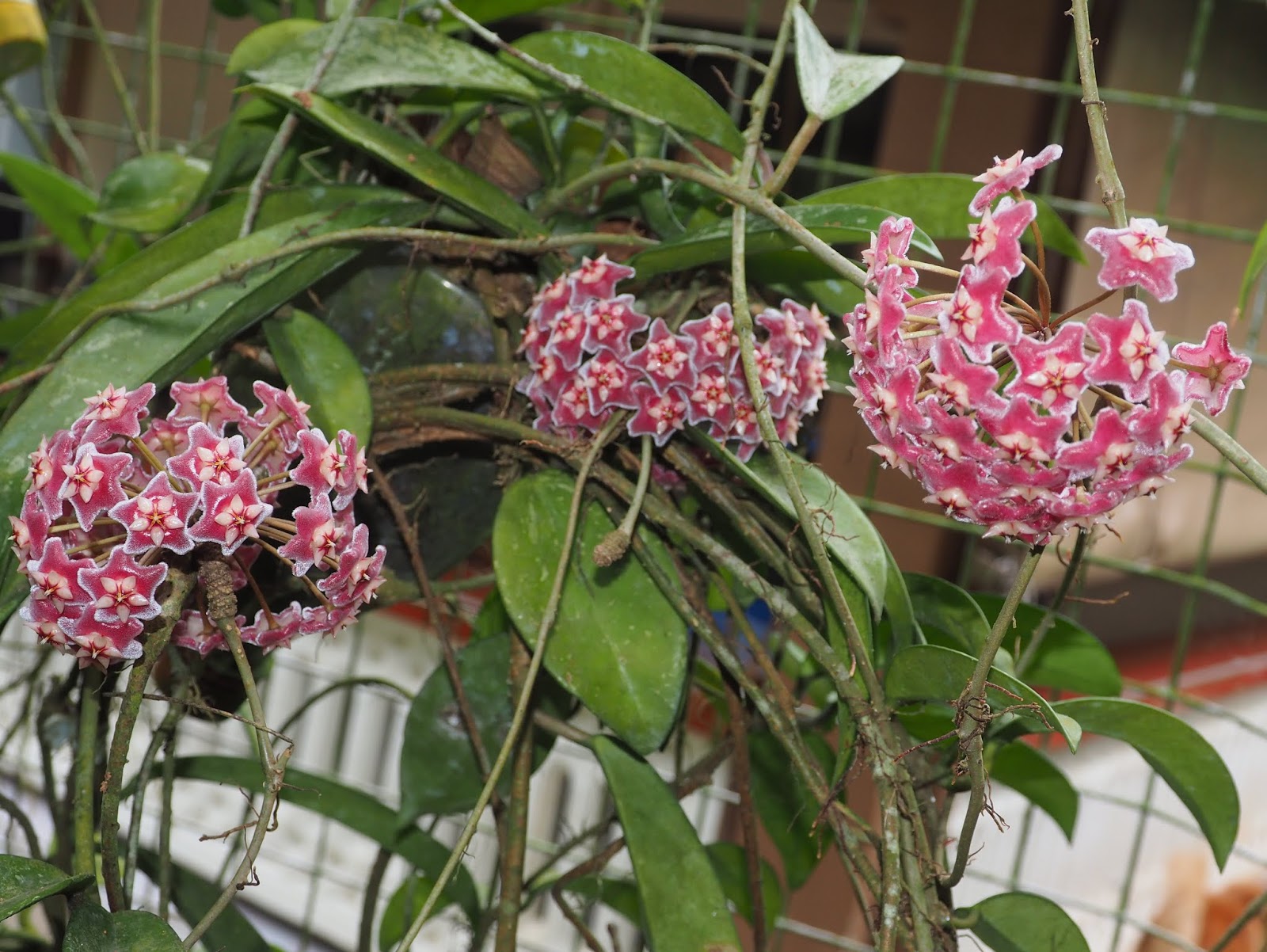
Hoya alwitriana is one of the newly documented hoyas endemic in the Philippines with the complete name and authors as
Hoya alwitriana Kloppenb., Siar, Guevarra & Carandang 2012. It is an accepted species listed at The International Plant Names Index.
I have acquired it a few years ago, but unlike my other hoyas it gave me a slumped growth, unwilling to respond to my normal care and yet did not die. After two years, it finally produced the long stem where the peduncles emerge. It was not just a peduncle as i expect from a newly flowering hoya plant, it gave 3 consecutive peduncles. Aside from that stem, there is a peduncle emerging from the base, just immediately almost at the soil level. It was fantastic, and those peduncles didn't stop producing flowers. The old flowers drop, and the next buds come soonest. I am so stunned.
The Buds
Here is the umbel arising from the base of the plant, just above the media surface.
Unopened buds have conspicuous brown dots or a semblance to sprinkling of dust particles.
The pedicels are conspicuously lovely in dark pink to maroon.
Newly Opened Flowers
opening flowers
newly opened flowers
5 hrs after opening showing the slightly reflexed corollas
Honeybee Magnet
Immediately after the flowers open in the morning, at about 8 a.m., a lot of honeybees converge on the flowers. These are our native
Apis cerana. All the umbels have their share of the honeybees. There are other open hoya flower species nearby, vitellina, pubicorolla, multiflora, pubicalyx, etc., but they only swarm on the
H. alwitriana flowers. This phenomenon amazed me, but after about 10 or 15 minutes they all left. The buzzing sounds were suddenly gone. I can only surmise that the first nectar during opening is the most delicious or important nectar for this bees, or maybe the nectar is available only during those precious minutes!
Not even one bee went to any of the already opened flowers. I watched the Hoya vitellina while opening, yet the bees seem to dislike it.
The plant
Its leaves are unusually bigger than the umbels, and can be described as oval in shape. There is a little curling down of the leaf margins. (Leaf characteristics can be technically read from the taxonomic publication)