Showing posts with label Orange You Glad its Friday. Show all posts

Thursday, May 17, 2018

Hippeastrum Blooms in May

When climate was still reliable, and it has not yet been acting like a stressed psychopath, hippeastrum here in the hot tropics wake up from dormancy after the first heavy rains. By heavy rains i mean continuous rains that lasted for long hours or overnight. That literally soaks the soil deep until the roots of trees are fully quenched. That is the time when after 2-3 days the grasses starts to produce the green carpet, and the weeds starts to simultaneously germinate.

However, with the so called "Climate Change", not only people are experiencing the dilemma and problems in planning agricultural planting. Even the plants themselves suffer chaotic behavior. And that response to rain is very obvious with the hippeastrum blooming. We got some long drizzles in March and April, enough to break dormancy of some hippeastrum bulbs. Definitely, i will not be getting again simultaneous blooms from my H puniceum hedges and mounds. Moreover, i will not be able to pollinate some blooms as they will not bloom simultaneously. This year is a repeat of last  year. It is now May and i am already getting the bad picture of the climate change outcome.

The first one and No. 3 are red while the others are orange.

1. Hippeastrum X johnsonii


2. Hippeastrum petiolatum 

    It has shorter growth, scape and smaller bulbs. The flowers are also smaller but compensated with more number of 4 flowers per scape.


3. Hippeastrum from seeds of Carol Noel
    
They have much bigger bulbs, longer leaves, taller scape and big flowers. The tips of the flowers also tend to flip that brings more grace to its look. They also have 4-5 flowers per scape. 


4. Hippeastrum puniceum


5. Hippeastrum puniceum 'Alberti' 

    This hybrid of H. puniceum is short, with leaves also dwarfed by the other species. However, the multipetalled flowers get the wonderful limelight. Besides, the blooms last for several days. 


6. Hippeastrum roseum

This is also a diminutive species, but taller than that of H. 'Alberti'. Leaves are more erect and        thicker too. However, the flowers per scape are normally just 2-3. Flower sizes are also narrower just like the H. petiolatum. The stripes however gives it the outstanding attraction. 


Wednesday, April 5, 2017

The Famous Milkweed

I have long been hearing and reading things about milkweed for a long time. It is famous because it is the host for the even more famous monarch butterflies, Danaus plexippus, which comes to the US from Mexico for a very long dramatic urge for something they haven't yet known why! The genetic make up of this butterfly is so unique, i guess! 

Then this milkweed is also controversial because it is said to suffer extinction in a place bombarded by a GMO herbicide that is reported to be erradicationg all weeds. Others also do not like it for being almost invasive that becomes a dilemma for farmers. Then comes the other sector at the other side of the fence, conserving the milkweed for the balance of biodiversity that is threatened by so many "advance technology" chemicals and so called development. 

Being not familiar with this weed, i got curious. I thought it is only growing in temperate countries, where a lot of controversies lie. Eventually, when i got addicted to growing hoyas, i learned that they are in the same family, Aclepiadaceae. Oh that even heightens my curiosity more! Lo and behold, when i visited (highlands) Baguio City last December i saw it in the Botanical Garden. This is Asclepias curassavica, also a host for the monarchs found here, Danaus chrysippus & Danaus melanippus,  different species from the famous one. I got some seeds to try in our hot lowlands, and it thrive very well as you can see in the following photos. 

growth is healthy without any predator at all, our monarchs haven't seen it yet

 there are different stages of blooming maturity in one stem, so i can see flowers every weekend

it gave me lots of photography angles and each single one is lovely

those seemingly dancing ladies in their vivid red gowns are so attractive
 
 I can see the flower parts resembling that of the hoya, being in the same family. It has been flowering since February and hasn't stopped since then. 

 Last March it started to produce the fruits, i can already imagine the seeds inside those pods. In hoyas the fruits are technically called follicles, i just don't know how they call it in milkweeds. I am sure more pods will develop later on, and i will be able to distribute seeds to friends. Maybe i already have the premonition that even here in the tropics where it is alien, it will also become more invasive. So good luck to us.

Tuesday, June 14, 2016

First Heavy Rains Outcome

Our rainy season this year officially started first week of June. It is a much awaited moment to alleviate our extreme heat and discomfort brought by the long dry season, an El Niño year. The effect for humans is not sudden, but a pacifier, as it is still very hot when we go out from 10:00am to 3:00pm. However, the almost daily thunderstorms in the afternoons bring rains to many places. Thunder and lightning are welcome if they will bring in the rains!

The plants are all rejoicing! The first heavy rains immediately produced the transformed look. Dormant bulbs and seeds emerged on cue. Drying branches immediately produced shoots, and in one week growth is already very prominent among all plants. Grasses, nonetheless, are the most responsive and quick. The roadsides suddenly get carpets of green, giving us panacea to bored minds reminiscent of dull surroundings. My soul suddenly engaged again to a new vibrant surroundings. Our garden in the province has been teeming with growths, scents, and lovely blooms. Hmmm, i was not able to go home last weekend, but i am sure lots of them are still there this weekend, waiting for me appreciate them more.

 A week after the first heavy rains, the air around our property is very well scented in the mornings. It is courtesy of the few coffee plants surviving on their own.

 The 2 photos above and the pompoms closed-up below is the 'Liberica' variety, made famous as "Kapeng Barako" in Batangas. The berries are the biggest among the coffee varieties of commerce. Since kids we are already familiar with drinking coffee, mostly from this "Kapeng Barako".


 The above coffee flowers are also sweetly scented, but is the 'Robusta' variety. Its berries are small and most famous in the nearby province of Cavite. It is used with other varieties to make lovely coffee blends, together with 'Éxcelsa' and 'Arabica' varieties. This last one is very aromatic as ground beans, but grow only in colder highlands.

Above is the response of the dormant bulbs of Hippeastrum puniceum to rain. Notice that other grasses around the mounds are not yet growing, but the scapes and some leaves are already showing luxurious growths. 

This is the growth of the H. puniceum in the same area 3 weeks after the first heavy rains. A lot more of the hedges are at the right side of the area, but my niece did not take the photos. She just sent it to me by FB.

close-up of the Hipeastrum puniceum

Hippeastrum roseum planted in a pot. The bloom is a bit smaller than H puniceum, but the stripes on the petals make it so lovely. By the way, i read somewhere that its more correct name is Rhodophiala rosea. 

 Hippeastrum johnsonii blooms ahead of the H puniceum. It actually emerged immediately a week after the first heavy rains.
 They made the area more lively and conspicuous. I wish there still are some followers when these dehisced. I hope to take more of their photos.

 even the back is so attractive for me


This crinum is newly planted, the friend who gave it to me said it becomes a very big plant. It hasn't acclimatized very well yet to the sun, so still under some potted plants, but it already produced that scape to become white scented blooms. Unfortunately, i didn't see the blooms.

You can still see the very dry grounds despite the first heavy rains. Grasses are not emerging yet, but this endemic Proiphys amboinensis already sent scape and leaves. Its umbel of white flowers is also scented and very beautiful. However, it only blooms once a year during this condition. The rest of the year will only be showing the maturing leaves, somehow looking like green hostas.

 this succulent, sedum, was already blooming during the dry season, but becomes lovelier with more flowers after the first rains.

Of course, i will not end my post without the hoyas. They also responded so well with the rains, the leaves got washed, environment gets colder and humidity increased. They love it. 

bloom of the above mother plant, Hoya pubicorolla formerly Hoya pubicalyx 'Black Dragon'

Hoya benguetensis plant (above) and close-up of the umbel (below)


 Hoya multiflora, they also call this shooting stars hoya

 the more common Hoya carnosa, lovely even if they are around for long

 Hoya mindorensis

 Hoya Viola

Next weekend when i go home, i am sure there are already lots of butterflies. Their larvae will have lots of host plants, which i am sure will now roam around our nectar plants including the hoyas. Butterflies, here i come!

Friday, April 1, 2016

Orangy-orange!

I am sure many of you already remember me saying that most of our flowers are all in very loud colors, as in yellows to oranges to reds. Sometimes i also almost complain that these loud colors are somehow boring my eyes. Somehow i wish to see more violets and blues, but they are very seldom seen especially during our dry season. We started our heat, scorching heat, in March. Our Easterlies that bring slightly cold air are now "ëxtinct", and we cannot feel anymore the air moving. At least we still have air to breath, lol.

Our temperature today in Metro Manila is 34°C with Heat Index of 38°C! Can you imagine how 38C feels? Our mitigating measure is just to stay indoors with the air conditioners. I am thankful that i still have work and the office provides for electricity bills.

So.....with those temperatures and scorching heat outside, will you still want to look at the colors of these flowers? They even aggravate my feelings of heat. By the way, these are all in my garden in the province and not in Metro Manila where i work. Despite the heat they are blooming profusely. They love the direct sun.

Ixora javanica

 Hoya valmayoriana

Hoya benguetensis (taken at night)

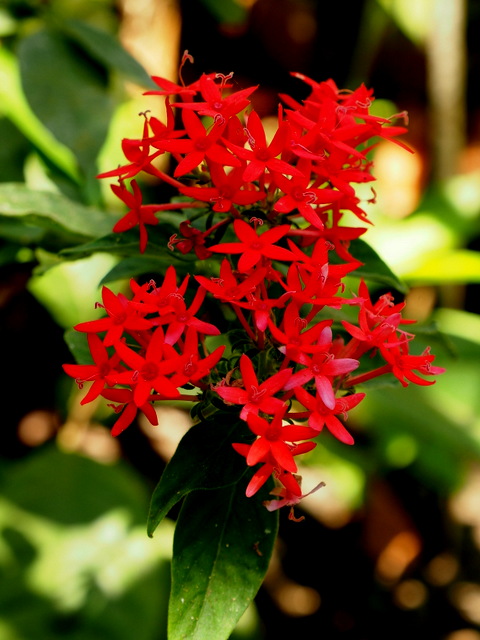
Pentas lanceolata

Thursday, March 10, 2016

In Focus: Hoya siariae


Hoya siariae is endemic to the Philippines, one of the hoya species from among the almost 200 species found in the country. Its name is from one of the researcher-collectors of hoyas, Dr. Monina Siar. After years of working at the University of the Philippines Los Banos, she succumbed to cancer at middle age. She was my friend and colleague, who introduced me to hoyas and gave me my H diversifolia. 

Buds of Hoya siariae are not flat, but with angular protruding sharp corners, unlike most hoyas.

There are a few color forms like the yellowish corolla, the pinkish (above), whitish and red. But i only have the first two and don't have the last two. 

It is a very prolific hoya, it produces many peduncles per plant and flowers frequently. Just like most hoyas, the flowers are pointing downwards, technically called positively geotropic or pointing to the earth. The corolla reflexes the tips backwards leaving an almost cup-shaped flowers. There is also a slight scent that i can't compare with anything, but it is pleasant. 

The corona of my two color forms are both fuschia or purplish color. 


 The above photo shows 3 different stages of blooming, the top is fully open, the right and bottom already about to close before dropping the flowers. They are only open for 2 days. 

This is the other color form, more pinkish corolla than the first one. It has a lot of umbels at the same time at different stages of blooming. Ants are very common partakers of nectar of this hoya.


This is a small seedling, producing true-to-type characteristics. It immediately flowered from its first long shoot. It is known to hoya growers that a long leafless vine normally produces the peduncles, and this one just did as a seedling. 

Just last year Kloppenburg changed its name to Hoya blashernaezii ssp. siariae. Hoya blashernaezii has the same form characteristics with pure yellow color.

Floral Friday Fotos

Orange You Glad It's Friday