Showing posts with label Floral Friday Fotos. Show all posts

Thursday, October 25, 2018

Costus speciosus, any taker?

I have long been fascinated with this plant. It has been growing for quite a long time already at the vicinity of the property, under the mango trees. Nobody is tending it, in fact it even received lots of unreasonable unattention and stressful beatings through time. These are maybe unintentional because it is growing at a sight that is used for dumping the cut plants from the garden and prunnings from nearby trees. The latest was dumping the full canopy of a big tamarind tree, when it was topped off to shorten it. So this plant is a "now-you-see-it, now-you-don't" entity! This time, it is a "Now-you-see-it" plant. And I am putting it at the limelight.

Despite the tortures it got through life, it still continue living, still continue with its purpose, still providing something for attention. I guess it succeeded because i now removed some debris covering some of its parts, cut the already long stems to grow new suckers, took lots of its pictures, and even posted its biography in this blogpost. Not a joke, but i am laughing at my thoughts just now!

 the open white bloom is a center of attention be it sideways

 ....or direct in front

moreso because of the color contrast with the deep red receptacle it emanates from


now look at the full green leaves supporting it to its pedestal

 Don't you think it is even more attractive?


 more spiral leaves, so it is also commonly called spiral ginger

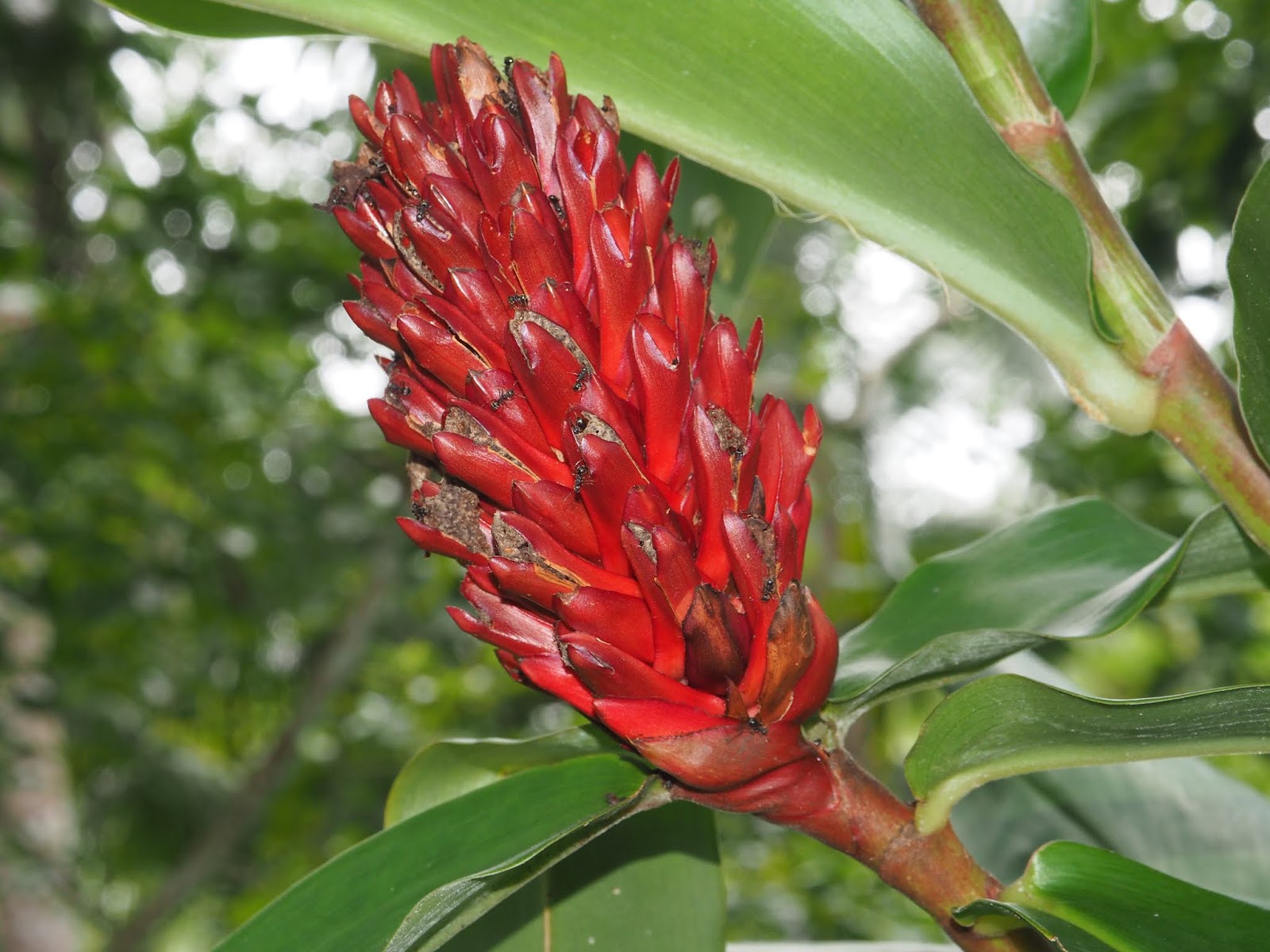
 and the brightly red bracts supporting the white flowers, sideview

 bracts- top view

Costus speciosus (synonym Heliocostus speciosus), spiral ginger, crepe ginger. 

The internet has lots of entries lately for this plant because some believe it is what they call the insulin plant, which aids in helping those with diabetes. I am not in the position to say whether this really is the real insulin plant as there are also insulin plants here in the country with different color forms. Moreover, i also don't know if the claim by insulin plant enthusiasts for diabetes is really true. I did not search for the scientific literatures on this matter, not for me to do that. 

But traditional knowledge in many countries in Asia, Southeast Asia and many literatures provide  different medicinal purposes of this plant. It is not only grown as medicinal plants but also as an ornamental. 

I looked at some sites selling this plant online, and the prices are not cheap by our organic plant standards here in the country. If only i can sell this, i can give them a lot and at lower prices, LOLs!

Monday, October 15, 2018

October Blooms and More

October is a crucial month with us in the Philippines. It is still within the rainy season, but the rains seem to be already subsiding. The intense heat of the sun is early for the season. Even at 7 o'clock in the morning it is already hot, you can imagine how it is at noon! Yes what you are thinking is correct, the heat at noon is very unfriendly to both humans and plants. We were joking that we are already at the height of the dry season because of the intense heat. We are already waiting for the typhoon because it comes always with rains, decreasing the heat and refilling our dams for our water in Metro Manila and irrigation water for our major crops like irrigated rice. I hope the cloud formation yesterday is an indication that there will still be incoming rains.

Gardening at home in the province last Sunday morning is already difficult due to the intense sun. I did not go out for butterflies as it is so hot. I already have the wide hat, but still the heat penetrates the head. I did not wear long sleeves, so my arms and hands got darker! Oh how wonderful to be just in the office in an airconditioned room. I said that because i am now already in the office in the big city, very tired but have to work.

Now i am trying to compile some pictures of the blooms and colors i was able to take yesterday. I almost forgot again the date and GBBD.

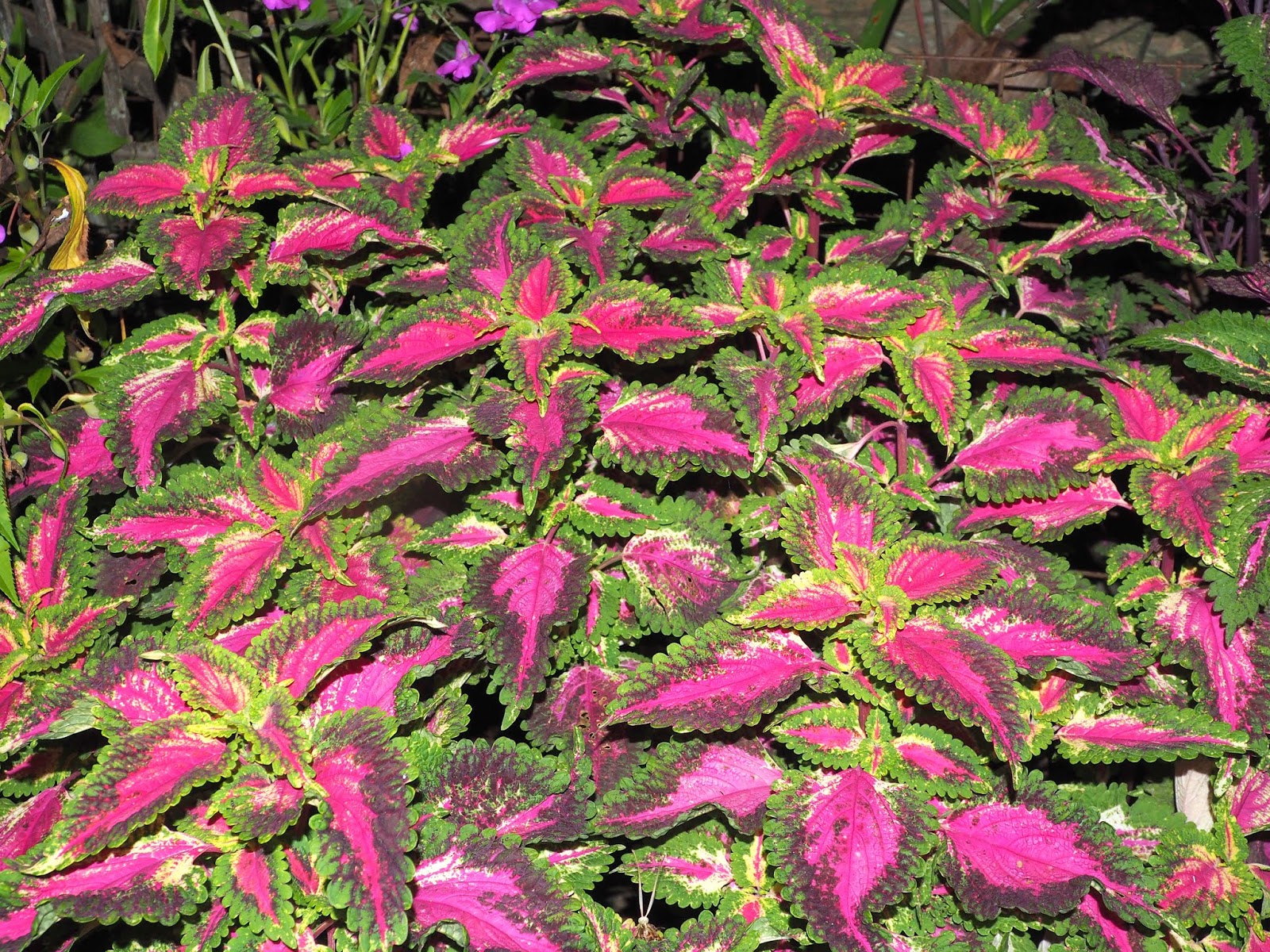
 Most of our colors come from the ornamental foliage like the Coleus blumei. I have 3 varieties and they give wonderful colors to our front yard. Above is the most lively. Can you see the very small tin can at the bottom? That is just where mother planted it, but some stems rooted on the ground, giving the full and wide clump arising from just one plant.

 This above 2nd variety of Coleus blumei, mayana in our dialect, is a bit darker with more erect growth habit. It gives more subtle color but definitely gives contrast to otherwise all green surroundings.
 The 3rd Coleus blumei variety is totally mauve in color, very dark but lovely too. The contrast against green is very drastic. It is not as prolific as the 1st because the container is much smaller and its other stems did not touch the ground for more roots.


Bothe above and below are from the same plant, just that the top picture are growing on the top portion receiving more direct sunlight. Picture below receives lesser direct light.


 This is an ornamental pineapple, which has been growing for 2 yrs now but still not yet fruiting. But it is lovely with just the leaves, so it is more fun.

 An Aglaonema hybrid also growing luxuriantly at a slightly shaded area.

 Alocasia sp. 

 Thunbergia erecta, growing inside the hoya house

My post will not be complete if hoyas are not included. They are always there with us giving lots of blooms. Above is Hoya diversifolia i let to climb the lanzones tree. Flowering season started last month and now is the profusion of the blooms. I went to the roof to get a better perspective of them.

 This is the lowest portion of the vines of Hoya diversifolia, almost reaching the fence of the hoya house. Some vines reached the top of the canopy and the flowering vines are on the top left side, with their blue sky background.

close-up of the blooms


Hoya blashernaezii

 Hoya buotii purple

 Hoya bifunda ssp. integra

 Hoya nakarensis, a cute little hoya, but floriferous with lots of umbels now

 If you think only flowers are blooming in my area, think again. Even a mushroom looks like a flower. It is growing at the growing point area of a coconut. That pointed shoot is the shoot primordia of the young coconut seedling. I shared this with you as i am very fascinated with an unusual mushroom to unusually grow in a very unusual area! LOL

The lanzones tree being conquered by the hoya blooms will not allow itself not be recognized and given attention. Its fruits are now ripening and in  1 - 2 weeks they are ready for human consumption. Can you see some hoya umbels at the small branch at the center of the picture, on top! I guess they are cohabiting in an ecological term called "commensalism", or they are called "commensal symbionts". Hoya benefits from the lanzones, which is not affected or benefitting from it at all. 

I hope you enjoyed my colors this October. You cannot feel our intense heat, but at least you can join me in appreciating our garden colors. Thank you so much. 


Thursday, October 4, 2018

A New Nectar Plant

 Most of you are very familiar with my new nectar plant. This grows not only in the tropics, but also in the sub-tropical climates. This is the common cosmos, scientifically known as Cosmos bipinnatus. The most commonly growing colors in our country are the yellow and orange colors. I found them everywhere, which becomes unrully and unsightly when the leaves are drying and the seeds are already drying on the plant.

Lately, i saw a friend has this red one and the butterflies are alighting, nectaring on them. So i asked for seeds which she sent November of last year. I immediately planted them, that to my surprise they flowered immediately when they are just about less than a foot tall. Their life cycle was too short because they die after flowering. I gathered all the seeds and stored them until this years rainy season again.

To my surprise not even one seed germinated. Probably, they belong to the recalcitrant seeds that must immediately be planted upon maturity. Fortunately, there is already this seedling which was already growing when i planted the seeds. This dropped to the soil last year but got stored in the soil and germinated after a few months. I wonder why that is possible! That remains to be a question to me till now.

We can see that the plant is already very tall even prior to flowering. It is more than 6 ft tall. I searched and found that it is a very well studied plant. It is photoperiodic and the internodes elongate much as a response to long days. No wonder my seedlings last year were very short at flowering because they are planted already during the short days. Hmmm, now i can manipulate that height next time, by choosing the photoperiod desired to attain an intended internode length. That would be interesting. 

By the way, i am forgetting that i got those seeds from a distant province because they are loved by her butterflies. To my surprise, i have yet to see any butterfly nectaring on my blossoms! A lot of them nectar on surrounding flowers, but not one even tried to alight on the red cosmos. What is happening! I only surmise that maybe there are more preferred flowers around it. Or probably, there are still very few cosmos flowers to attract the butterflies. I don't know.

 So i just content myself in taking different angles of the flowers, the back against a lot of bokeh as above....

...the side angle with the pollens showing...


...or the top with the petals slightly angling upwards! 

I am a bit disappointed that butterflies are not nectaring on them. But still i will again plant those seeds to have a patch with more flowers to invite the butterflies. Next time i have many results to observe, many parameters to test. That makes the unexciting more exciting, don't you think so! Let us all see the next generation of red cosmos with moderate stands, lots of flowers on a single patch, shorter internodes and with lots of butterflies....See you next time around.


Wednesday, September 12, 2018

White Scented Flowers

African Crinum Lily, Crinum jagus

A friend gave me a crinum lily a few years ago, which i planted in a bigger pot. For the first year it flowered once but i did not see it in person. There was also an episode when it was fully defoliated by a lily caterpillar moth, eating all the leaves and leaf sheaths, leaving only the base trunk and the bulb. It didn't seem to be bothered as it produced more robust and healthier leaves than before. Afterwards it produced a scape with a few flowers. The good thing about this lily is the ability to produce more flowerings per year.

It even has a sweet scent discernible when you are near it. Ours is planted  near the terrace so a whif of that scent goes with the wind for some moments. The flowers though do not bloom at the same time, and droop always. I wonder if the flowers are so heavy while the neck are soft to carry them upright. Moreover, the flowers last only for one day. 


I was so curious once that i opened a still close bud like above to see the conditions of the pollen inside. 

 It turned out that pollens are already mature and ready for pollination even before opening the petals.

Curiosity got into me the past week so i pollinated it with some hippeastrum pollens,  because a few hippeastrum are simultaneously blooming with it. I checked after a few days and i guess it did not succeed. Intergeneric breeding might not be possible with it, or there are factors which hindered the fertilization. Those however are very difficult to answer with just a few pollinations i did, which i also did not vary any conditions as maturity of pollen and stigma, conditions of the day, etc. 

The pollens immediately become black a few hours after opening. The stigma stalk also curved upwards which to me signals stigma receptivity for fertilization. I should also consider this factor when i do crossing next time.

However, i searched the net and nothing of the sort has been done yet. But there was a dissertation in Australia showing the factors that impede fertilization, once before and once after. However the actual study succeding fertilization of crinum with hippeastrum is still not available. With that, i will not do it again next time. Just let them BE!

Monday, July 30, 2018

Endemic Plant Pandakaki

A plant with white small flowers, scattered in our fallowed areas or in little thickets under coconut trees are these shrubs we locally call pandakaki, Tabernaemontana pandacaqui. It is native to the Philippines and other neighboring Asian countries. It is very resistant to drought that we can see them leafless during dry seasons, but eventually grow again with the coming rainy months. I observed that in drier patches they do not grow as tall as this picture, some are just about a foot tall. The stems specially the base of the plant are strong and cannot just be cut or pulled off by hands. We have a lot of this plants in our area and around the surrounding localities. It is reported to be common in Asia, and the Pacific Islands including Australia.


The flowers are white with a bit wavy petals. They do not open simultaneously in big clusters unlike the umbels of some plants in the Apocynaceae family. 

 Flowers are just a little over 1 centimeter in diameter, but they are cute, don't you think so?

It looks like a spinning wheel, and it is loved also by some butterflies.

 The fruits are technically called follicles, and normally emerge as a pair like above. They start as green which changes color as it ripens.

color already turning orange

The follicles eventually become orange as they ripen. 

The black seeds are enclosed in red pulps, seemingly very attractive to eat. These pictures are just as i see them in the wild normal habitat. With those lots of seeds inside a folicle, i can imagine why there are lots of plants i see all around our area in the province. 


Extracts of all parts of the pandacaqui plant is reported to have alkaloids and triterpenoids. It is also known to have medicinal properties. The internet is full of reports on its uses and concoctions and plants are being sold online. 

In my area, i haven't known any use for medicinal purposes, but it is commonly used as landscape materials. It is not very difficult to grow and very tolerant to drought, which probably made it good in ornamental industry. I also observed it to be good nectar plants for some butterfy species, so it can be both used in landscaping and in butterfly gardening. 


Thursday, July 12, 2018

Garden Bloggers Bloom Day for July

Our Rainy Season started in June this year. So our plants this July are already very happy, everything sprouting from rain saturation. I went home some weekends specifically to catch the blooms and to post them here for GBBD. More plants start to show their growth, blooming happily with their plenty of food uptake. And the photographer, in return, is happily documenting their conditions as well. These are just some of the more obviously conspicuous blooms resulting from the heavy rains.

 the sleeping shoots were shaken from slumber and produced blooms.

 The lilies were terminated off their dormancy, like this Scadoxus multiflorus or Blood Lily. We don't see them during the dry season, as their leaves are gone with only their live bulbs in the soil. With the first heavy rains they regain growth, all the flowers sprout first before the leaves. They sprouted a bit staggeredly, so we can see the red umbels for at least 2 weeks.


 I also observed that the stingless bees swarm on them with their legs full of pollen to be brought to their hives. In a month the umbels will die and be replaced with green leaves, again accumulating food to prepare for their next dormancy in the dry season.

 Crinum jagus


Crinum zeylanicum

Pteroceras ungiculatum (orchid)

This is an endemic orchid in the country. It has been there hanging on the trunks of my trees, self-supporting, a bit dying during the dry season but suddenly comes to life with blooms when the rains come. It also produces a lot of pods. 

Mussaenda Dona Luz

Those colorful parts are bracts, enclosing the small yellow flowers. We cut all those branches 2x a year when those bracts wither. The succeeding shoots will enable the tree to accumulate food again for the next flowering, which coincides just after the first heavy rains. 


Clausena sp. 

This small tree belongs to the Rutaceae which include the citrus. Flowers entice a lot of butterflies there on top. It is called "malarayap" in the our local term because the leaves emit a scent like that of "dayap" or our local lime. 

Tabernaemontana pandacaqui (pandakaki)

This is a bush which luxuriantly grows in our areas, fallowed lands, under coconut trees, vacant or marginal lands,  everywhere in our vicinity. The butterflies also love nectaring on them. It produces very colorful orange pods when ripe that can be easily seen from a distant, in contrast with the green environment. 

Hoya lacunosa 

Hoya lacunosa is one of the small-leaves hoya, with equally small umbels. But its overpowering scent makes up for the size of the flowers. After the heavy rains it produced a lot of umbels. The above plant alone has 15 umbels. 

Hoya lacunosa 

Hoya obscura

This plant is also considered small because of the leaves, but it is a bit bigger than H. lacunosa. Even just the lacunosa or the obscura flowers alone are open, one can immediately realize that a hoya is in bloom in the hoya enclosure. The scent is easily discernible at 5 meter radius or 10 m diameter. 

Pseudorhipsalis ramulosa (syn. Disocactus ramulosus) 

This is a red-leafed hanging cactus whose fruits are so small at less than a centimeter in diameter, changing color from green to white as they mature. Every notch on the leaves produce flowers that eventually become fruits. 


Even the fungi are happy emerging with the start of the rainy season as the brown fungus above and the yellow ones below. I do not know their identification.


It is my first time to upload a video in my posts here, but i cannot control sharing with you the happiness of those bees nectaring on the newly opening Hoya alwitriana. This hoya is so much different than most because it opens in the morning, when the bees and other insects are starting to forage for nectar and pollen. Most hoyas open late in the afternoon to early evening. This scene above always happen when an umbel opens but the bees leave after a few minutes.

It is so nice to watch something like this in nature, and the bees do not seem to mind a human watching them. Those honey bees are also endemic in the country, Apis cerana. Their honey is my most prefered honey among the honey producing bees.