Showing posts with label Saturday Critters. Show all posts

Tuesday, February 27, 2018

Wildflowers for Wednesday and for Butterflies

I have not been posting for Wildflower Wednesday, as i normally forget the 4th Wednesday of the month. But i remember it when it is not time to post. Now i suddenly realize it and thanks circumstances that tomorrow is the 4th Wednesday. I am in time for the link of Gail's Clay and Limestone. Now the problem is to search for my wildflowers still scaterred in my so many files.

Here are some of them as remnants of our rainy season growths. I warn you they are mostly taken because of butterflies!


Above and Below is Plumbago zeylanica, an endemic white plumbago species in the country. I found this in the wild and amazed that a butterfly is ovipositing on its young flower buds. I have lots of the red plumbago, but i haven't observed any butterflies nectaring on them or any larva eating them.

Zebra Blue or Plumbago Blue, Leptotes plinius leopardus, a lycaenid

 the clump of Plumbago zeylanica

a hover fly and a wasp moth nectaring on the Mikania micrantha

 Mikania micrantha, (Mile-a-minute weed as called in Singapore), is an introduced species, a vine, and as expected from alien species they are very invasive. It can easily kill a native plant that it can totally cover during the rainy season. At least it has some function as nectar plants for the butterflies and other insects.


Dwarf Crow and Grey Glassy Tiger on porter weed, Stachetarpheta jamaicensis


 Glassy Tiger, Parantica vitrina vitrina and Snow Flat, Tagiades japetus titus


 a large clump of porter weed, Stachetarpheta jamaicensis on a fallowed grassy area

a blue weed

this Tiny Grass Blue, Zizina hylax pygmaea, is the tiniest butterfly in my area that is less than a centimeter both in length and in width. It is so frantic and sometimes difficult to photograph as it alights again after minutes. But when it is still early they can be easily posing with the camera and later when they feed and oviposit on the very short grasses. 

 this is the NOID blue flowers with also very short stems

Aerva lanata (Amaranthaceae), only a few insects alight on them, yet i find them pretty too. We have lots of this in our property and on adjacent uncultivated lands. I just realized upon learning its name that it has lots of medicinal properties and antioxidant components. There are even dried plants being sold formally in the internet and on ebay. 

Aerva lanata growing abundantly in our property

Another low weed that flowers profusely and loved by tigers and skippers. This Grey Glassy Tiger, Ideopsis juventa manillana, kept on coming back and forth from this lump of flowers.

 This is the whole stand of the weed as it starts to produce flowers, just about 2 ft tall. The dry season has started and this seems to be just starting to reproduce. At least the butterflies have alternatives from the flowers that already finished maturity for the rainy season.

Wildflower Wednesday


Saturday, April 22, 2017

Camera Pets!

My niece always wants to pose for the camera since she was a kid. That hasn't diminished through the years. Because of the digital technology and the easy access to photos with celfones, she has lots of them. I wonder why these days the so called millenials are so fond of taking their own photos. It is almost like second thoughts to them to raise their fones, smile and click.

I am not fond of taking people's photos, only for special occassions, on trips as tourists to say we were there, or when obliged in group pictures. But i seldom stay in front, nor be prominently displayed in focus. I noticed that there are also older people who take their own photos seemingly like they are still young, or mimick the actions of the millenials. I laughed at the word selfie, groupie, and i chuckled at the words by an Indian blogger friend "doublefie". Oh how easy we are in coining words, they come with the times, but very functional.

Back to my niece. She knows i don't like to take much of her photos anymore. She already graduated from college and already working. So in the following pictures she took someone to go with her. She was able to oblige me even without words. There i am hooked to click!

 We have 2 mother goats, and they both have newly born pair of kids.

 they are pets and the kids come to the house when hungry

 They even smell better than dogs, even if they don't bathe. And look
 at those soft eyes, they are so lovable and endearing.

 my niece and nephew always hug them at this young age

These are the brown pair from Goat Mom One, and Goat Mom Two has a pair of blacks, the same style as the browns. One of them is purely black and the twin has white. 

Friday, March 24, 2017

Garden Residents Popped Again

 It is already very very dry and hot again. Our dry season just started in March, but the heat seems to already be in April-May, the height of our intense 2nd season. Here in Metro Manila the highest recorded temperature now is 31°C with Heat Index of 39°C. Can you relate to these conditions, when you are still expecting for spring, still in the midst of very cold winter? I remember reading something like, the hot countries will get hotter, while cold countries will even be colder! OMG, we are being punished! If this is not climate change, then what is inflicting us these conditions?

Anyway, enough of that, that is a human being talking. I wonder how the smaller garden creatures feel. They are still there, as if not feeling the heat. They just hid among the flowers or leaves. They seem to be just feeling great, as long as there is food.

This spider doesn't have the back abdomen marks as i posted before, with smiling faces, or scary old men's snare!
 

Larvae still eats available leaves, but that has to be in colder mornings, or else their bodies will not tolerate the oven-like temps. That right hoya leaf is the damage of that larva at the left.

This sphinx moth probably just emerged from the pupa, as the wings look great. However maybe that bald head is a result of bumping into something hard like glass window.
 
 A young praying mantis hopefully gets its prey, or hopefully will not be seen by its predator.
 These 2 photos are just pictures of only one spider. Above is taken towards the sky, while below is taken at its eye level.It just shows that expressions of anything only depends on the perspective of the onlooker. Top looks like that of an angry dog or angry old man. On the other hand the bottom looks like a smiling young creature, even with a ribbon on its head. So all of us don't judge immediately of what we see, let sometime pass until you change your perspective.


We are into perspective, so what do you see in the above photo. I will be very curious of what you think, or see, or feel, or what is your perspective. I see a poodle, don't you think so? Please let me know. I will tell you the answer at the comments.

As for me......later!


Friday, February 17, 2017

Critters, critters!

Garden Critters

I looked for the meaning of critters, and found that it is an informal word for any living creature, from a wolf to a spider! Oh so it would be correct to put what i am thinking of in this post. Originally, i thought it only refers to the small animals like the insects or spiders. I am glad i checked it first, that is the beauty of the digital age, and that Google is just a click away!


 I have been following this inside the room one morning, it bumped several times into the closed glass window. Then it dropped to the floor, i guess it died. Sorry! Or probably it got hit when something got its hind wings, a big part is torn.

 PALM KING, Amathusia phidippus

This is probably its partner, although i am not aware how to distinguish the sexes. It is not a butterfly but a moth, a big moth.
 This one is also a moth, but i completely do not know its ID

 a small butterfly on a Turnera ulmifolia flower

PYRALID MOTH, Doloessa sp(Pyralidae; Galleriinae)

Can you see the owner of this long house? Of course it is a spider, the web is there.

I touched it, and suddenly it crawled upward leaving a space at the middle. There you can see it on top of the long house. The long house is a decoy to show the predators that it might be big, or so that the predators will not see where the real spider is located. The house provides for a good mimic. 

Sunday, January 15, 2017

Saturday, December 10, 2016

Critters on my Hoya

Hoya ilagiorum is one of the most prolific of the hoyas. After the blooms dehisce, it starts preparing for the buds again, and in a few weeks blooms appear once more. It also has a slight aroma that is not actually bad, but not also very prominent to the senses. It blooms in the afternoon and remains open for 3-4 days. Some hoya species rest for a while from blooming, but this one never fails to delight us. And of course, its color is very attractive.

a typical Hoya ilagiorum umbel

last week i saw some flowers without the corona, or those whitish stars protruding from the corolla

I searched inside the umbel, and this very small larva about 2 cm in length is the culprit. I removed it and put in a farther place. Unfortunately, some chickens followed me and saw it. That was a food chain happening before me. 

The other umbel just newly opened, and this butterfly cannot resist its scent and nectar. The nice thing about this butterfly is its lingering habit, not always fluttering rapidly like the others. It is friendly to the camera and delightful for me. Idiopsis juventa manillana

Even if my time is very much occupied, if the butterflies alight on the hoya, i cannot resist taking their pictures. I felt like it was my reward for so much time devoted to the hoyas, neglecting to chase the butterflies. But if they are together, then i can have both in one shot, 2 birds in one stone!

Friday, June 3, 2016

Hoya Critters

 A lot of critters make the hoya garden their home. Some are on the leaves, some on the stems, some on the spaces between them, but most of them inhabit the umbels. These are parts of the flowers that could give them a lot of food as well as safety. There are those that do not anymore leave once they have experienced the luxury of living within the umbel.  And many of those are transient dwellers that only come at night when the nectar is available.

It is now raining once-in-a while in our area, so we are already considered at the wet season. More critters might probably be happier, however these are photos still during the dry season. You can see that the leaves are still dirty full of dust and debris. We have difficulty with water supply so the plants only receive them at the root areas, only at night. 

 This cotton bug, Dysdercus cingulatus, are common residents of hoyas. They normally stay on the stems and leaves, but this one lingered at the developing umbel. I sucks juices, but maybe if their population is not plenty they will not pose a big problem to the plants. I pity killing them, they are so lovely, so i just let them there. I hope there are predators, so only a few will be left sucking my hoyas.

Again here is the cotton bug now on the bigger buds. I cannot see the proboscis at the act of sucking, so i cannot fully say or judge it based on my suspicion. But i know it is a sucker for juices, so maybe i was just not able to fully document it in action.

Those white crab spiders are perennial residents inside the umbels. They walk slowly, but drops through their lifeline when provoked. I call them the smiling spider because of the smiling design at its back. They hide inside the umbel to ambush whatever insect they can hold on to. This time it was successful with a bee, as bees are nectar seekers at daytime. 

If you look closely there are very small flies that roam around the predator and the prey. I guess they are hoping for the leftovers of the spider. These small flies always immediately roam around during an ambush, trying to sip on maybe the crumbs! hahaha.

This one is a night moth, and i found it at the vicinity of the hoya garden. I also cannot say it is a perpetrator of the crime of stealing the nectar, the juice, or whatever. Nor will i be able to say it is an accomplice! Whatever is its purpose at the vicinity of the crime did not give me a is so faprima facie evidence. Whatever, it is a lovely moth with those lacey abstract design on the wings.  

This is a daytime visitor, very difficult to picture favorably as it is always fluttering non-stop. It can easily say it is exempted of any crime because the evidence shows it is sipping nectar only on the pentas flowers. Honestly, i haven't seen it on any hoya flowers yet. It is so fast and doesn't want to wander inside the hoya plants.


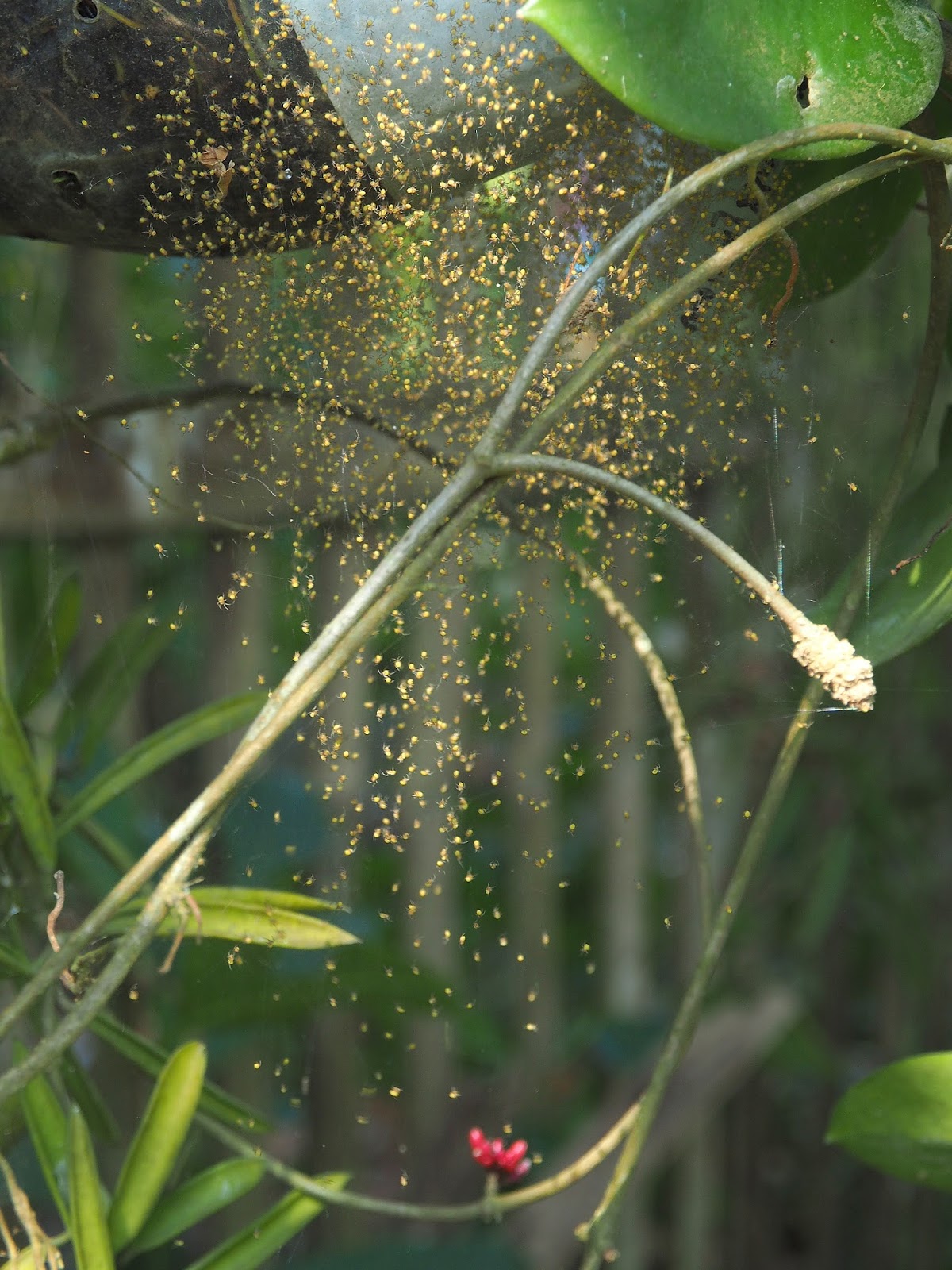
This is the most common sight during the dry season. And those millions of baby spiders or "spiderlets" sparkle with the morning sunshine. They stay in a small hanging area in space with only holds to the plants, but when agitated a bit even by the wind they start falling on the lifelines, like the photo above. If i don't stop agitation they will fully migrate to any objects around, but i normally stop after they scattered. Eventually when the nuisance stops, they all slowly go up again to a convergence. I just didn't observe if their mother or any adult is left there to tend to them. I believe they were left on their own for their own survival. The plenty of numbers ensure a few that will survive and continue the generation.

And if you think only the minute insects go to the hoya garden, oh no, you are wrong. This is the most intimidating or scary among the hoya visitors. It climbs and eat whatever that mouth can hold on. But in fairness, this is the mother who doesn't come near the garden because it is on leash at its own house. Its 2 kids are the most irritating, hard headed and stubborn among all them. Sometimes i get too mad at them that i throw small stones to drive them away!