Showing posts with label Hoya. Show all posts

Thursday, November 15, 2018

November Blooms

I am maybe biased to flowers that cater to butterflies. That is my disclaimer because most of the plants you will see in this post are nectar plants, loved by butterflies, which in turn i love too!

 
 Asystasia intrusa can be invasive, but i always have them for, of course you know what! But if isolated in numbers in plates like the above, they can be beautiful too.

 Pentas lanceolata are favored by the Scarlet Mormon. They favor those in umbels because they will not leave the area for another flower, just insert their proboscis in the next flower within the umbel. Butterflies know energy conservation too.

another Pentas lanceolata color form, favored by the tigers

 This hippeastrum is the only species that bloom more than once a year. In fact this is its 4th bloom. When under the net protection it produced 6 flowers in one scape. 

 This is my first time to see the flowers of Curcuma longa or turmeric.  Actually, above are the bracts, the flowers already gone. Those almost rotten debris at the axils of the bracts are the decomposing flowers.

top view of the Curcuma longa bracts

 This is only a leaf, but it is as lovely as a bloom. It is one of the colorful caladiums. 

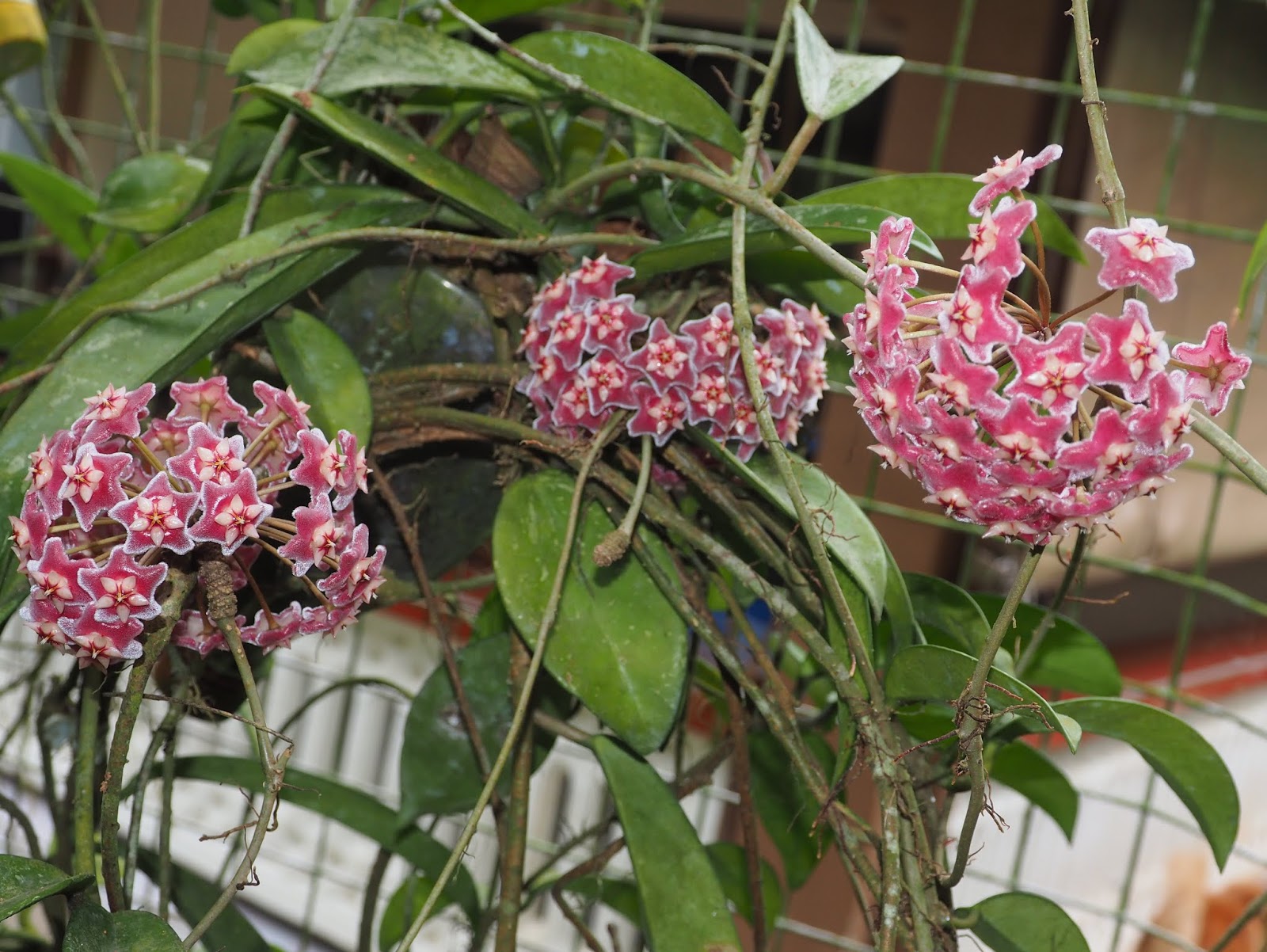
Hoya pubicalyx 'Black Dragon' syn. Hoya pubicorolla

 My Garden Bloggers Blooms post is not complete without the hoyas. They are the special flowers in my garden with their own enclosure and get more attention from me and my sister at home. I just go home on weekends and i only do some jobs and taking their pictures. I confess my bias is fully with them together with butterflies!

 Hoya alwitriana starting to open. This is one of the very few hoyas that blooms in the morning, most of them opens in the late afternoon.

 Hoya pubicalyx

 Hoya odorata

Hoya bifunda ssp. integra

Hoya nakarensis


Thursday, July 12, 2018

Garden Bloggers Bloom Day for July

Our Rainy Season started in June this year. So our plants this July are already very happy, everything sprouting from rain saturation. I went home some weekends specifically to catch the blooms and to post them here for GBBD. More plants start to show their growth, blooming happily with their plenty of food uptake. And the photographer, in return, is happily documenting their conditions as well. These are just some of the more obviously conspicuous blooms resulting from the heavy rains.

 the sleeping shoots were shaken from slumber and produced blooms.

 The lilies were terminated off their dormancy, like this Scadoxus multiflorus or Blood Lily. We don't see them during the dry season, as their leaves are gone with only their live bulbs in the soil. With the first heavy rains they regain growth, all the flowers sprout first before the leaves. They sprouted a bit staggeredly, so we can see the red umbels for at least 2 weeks.


 I also observed that the stingless bees swarm on them with their legs full of pollen to be brought to their hives. In a month the umbels will die and be replaced with green leaves, again accumulating food to prepare for their next dormancy in the dry season.

 Crinum jagus


Crinum zeylanicum

Pteroceras ungiculatum (orchid)

This is an endemic orchid in the country. It has been there hanging on the trunks of my trees, self-supporting, a bit dying during the dry season but suddenly comes to life with blooms when the rains come. It also produces a lot of pods. 

Mussaenda Dona Luz

Those colorful parts are bracts, enclosing the small yellow flowers. We cut all those branches 2x a year when those bracts wither. The succeeding shoots will enable the tree to accumulate food again for the next flowering, which coincides just after the first heavy rains. 


Clausena sp. 

This small tree belongs to the Rutaceae which include the citrus. Flowers entice a lot of butterflies there on top. It is called "malarayap" in the our local term because the leaves emit a scent like that of "dayap" or our local lime. 

Tabernaemontana pandacaqui (pandakaki)

This is a bush which luxuriantly grows in our areas, fallowed lands, under coconut trees, vacant or marginal lands,  everywhere in our vicinity. The butterflies also love nectaring on them. It produces very colorful orange pods when ripe that can be easily seen from a distant, in contrast with the green environment. 

Hoya lacunosa 

Hoya lacunosa is one of the small-leaves hoya, with equally small umbels. But its overpowering scent makes up for the size of the flowers. After the heavy rains it produced a lot of umbels. The above plant alone has 15 umbels. 

Hoya lacunosa 

Hoya obscura

This plant is also considered small because of the leaves, but it is a bit bigger than H. lacunosa. Even just the lacunosa or the obscura flowers alone are open, one can immediately realize that a hoya is in bloom in the hoya enclosure. The scent is easily discernible at 5 meter radius or 10 m diameter. 

Pseudorhipsalis ramulosa (syn. Disocactus ramulosus) 

This is a red-leafed hanging cactus whose fruits are so small at less than a centimeter in diameter, changing color from green to white as they mature. Every notch on the leaves produce flowers that eventually become fruits. 


Even the fungi are happy emerging with the start of the rainy season as the brown fungus above and the yellow ones below. I do not know their identification.


It is my first time to upload a video in my posts here, but i cannot control sharing with you the happiness of those bees nectaring on the newly opening Hoya alwitriana. This hoya is so much different than most because it opens in the morning, when the bees and other insects are starting to forage for nectar and pollen. Most hoyas open late in the afternoon to early evening. This scene above always happen when an umbel opens but the bees leave after a few minutes.

It is so nice to watch something like this in nature, and the bees do not seem to mind a human watching them. Those honey bees are also endemic in the country, Apis cerana. Their honey is my most prefered honey among the honey producing bees.


Monday, May 28, 2018

Hoyas in May 2018

I have not been posting hoya lately. There are lots of  reasons i can cite, but actually the foremost of them is the bigger share of the time for butterflies. With only a few hours i can spare for editing the photos, actually it is not really full editing but mainly just cropping and doing the contrast; there is only a very limited time left fot anything. I even cannot make scheduled posts like the monthly Garden Bloggers Bloom Day.

When not going home on weekends, i can edit more and contemplate on what to post next. But still my posting is always spontaneous, whatever comes to mind after looking at the photos. If there is a demand-driven production, i have photo-driven posts!


Above and Below: The ever reliable Hoya carnosa is always a sight to behold when in bloom. It always gives a very distinct round umbel that is born on leafless stems. My old plant which has been producing more than 20 umbels at a blooming time almost died 2 years ago. I was able to arrest death, but blooming stopped. I got a severe case of root rotting caused by not so well draining media. It has been out of the ICU, but still recuperating from an extreme case of Near Death Experience! 


Another species that brings a lot of awe is this Hoya crassicaulis. The normal characteristics is the reflexing corona, so those brown edges are supposed to be bent backwards. However, this particular plant showed this character i supposed to be just because of the plenty of flowers crowding so much in a space-limited umbel, which hindered the corolla from reflexing. This plant also went through a detour and has not been blooming for many months. I already made some cuttings to preempt the unexpected death. To my surprise, the cutting from this plant also produced a true-to-type character of this mother, the inability to reflex. That means the corollas stayed in place like those above, showing exageratedly the bright tip colors. Isn't it incredible?

 brightly colored Hoya ilagiorum

It is not growing profusely like the other species. The plant remains a bit dwindling without more growths, that i cannot even get some peduncle-free stems for cuttings. However, it is so diligent in producing blooms. As soon as they dehisce, the new buds immediately go into development, and you will not wait for long. 

 Hoya multiflora is not a vine, but a shrub with erect stems. The unique characteristics of this is its floriferousness. It is not uncommon to see a stem with peduncles blooming in every node. However, mine is not that floriferous because we have just been through a very hot dry season. Very hot air lessens its rate of growth and blooming.


 I call this Hoya bifunda ssp. integra. However, that name is still not conclusive. It belongs to the camphorifolia complex, the smaller flowered hoyas. The diameter of the umbel is only 1-1.5 inch in diameter, and the flowers do not last for 2 days. But when the umbel is full it lends beautifully to photography. As one of my colleagues say, "the other half of hoya growing is in photography". And i fully agree.

 Hoya buotii is called the Starfish Hoya, you will agree that each flower really looks like a starfish. I have four variations of its color and all of them are lovely. There is the more purple, while another is full yellow, the fourth one is yellow with dark brown corona.

 Above is a variety maybe of Hoya crassicaulis-incrassata group. It is Hoya 'Viola'. The characteristics of reflexing corolla in a very round umbel is coupled with the same lemony scent. It is also favored by some butterflies, which i most prefer. The leaves however are much bigger with distinct obvious venation.

the plant of a Hoya carnossa seedling is blooming now
 
Hoya pubicorolla ssp. anthracina is formerly called Hoya pubicalyx 'Black Dragon'. Compared to H pubicalyx, it has shiny, clear lighter green leaves and green pedicels. There are actually two color variations with strongly black and slightly black, i got the latter. I am still hoping i can get the 1st color form, but my source will still be coming from Sweden. Although it is endemic to the Philippines, sadly i do not have the privilege to get it locally. 

Hoya celata is called Hoya pubicalyx 'White Dragon' by some foreign growers. Its leaves are very similar to H. pubicorolla ssp. anthracina, just that the flowers are white. Same as the latter it is also very viny with longer internodes. Basically, they just differ in color. 

Hoya verticillata variegated. Like all variegated plants, it is growing not as fast as their normal green forms. I am not favored to see it in full bloom, and the photo above is taken the day after the flowers closed. But unlike other hoya, the flowers open again the next 2 days in the morning, although not as fully exposed as the first time. 

This Hoya pubicorolla ssp. anthracina inadvertently climbed the lanzones tree already, following the Hoya diversifolia, which i actually trained to climb it. Apparently, most of them behave more lively and happier when on trees simulating the natural forest habitat. Because this has already claimed its niche, i already allowed it to remain there.


Some hoyas i pictured at night. They are already wanting for more space, but i do not have what they want. I cannot even provide the much needed water. Anyway, i hope the rainy season is coming early next month, so they will look happier, fuller with more blooms!


Thursday, October 26, 2017

In Focus: Hoya pubicorolla ssp. anthracina

Hoya pubicorolla ssp. anthracina is well-known in the past years as Hoya pubicalyx 'Black Dragon'. The latter is just a coined 'variety' in commerce to describe its blackish color. The collector is from here in the country, but sold his collection first as export to the western countries but not locally. In effect, the foreign collectors already have it growing beautifully and all of us here in the country are in awe where we can get it. I was just lucky to have connection with some people and was able to get a plant from the collector. Later, when my plant flowered i was so surprised as it is not as black as the photos circling in the net.

I just learned lately that there are two forms of this as collected here. One was real black and the second is the more maroon one just like mine, as presented in the photos below. A friend from Europe offered to give me a cutting of the black form, know someone who might come here for the holidays. I hope there will be a person to bring that from Europe to Manila. I am almost close to praying!

The newer name, Hoya pubicorolla ssp. anthracina, is given by RD Kloppenburg, a former collector who gave names to most of the Philippine hoyas. He was also responsible for the controversial names of many species, as he sometimes give a new name to already identified ones. Lack of knowledge on the characteristics of hoyas to change forms, colors, and leaves shapes through time and growing conditions predisposed the Philippine hoyas to have chaotic names, others actually said "naming of Philippine hoyas is a mess".  Nobody seems to be entering the mess to correct it. 

newly opening buds


side view of the umbel of the newly opening buds

another view of the whole umbel


Sometimes the form is like above, but sometimes it is like below. They seem to be different, but they are in the same plant. That is true with the corolla, but the corona of above and below are the same. 


I love its characteristics of producing continuous umbels for many months. They seem to be always there every month, however there are not as many umbels in one plant as compared to Hoya carnosa. 


Above is the typical plant, shiny green leaves without very prominent venations. The internodes are a bit longer than the other Hoya pubicalyx, but the shape and size of the umbels are just like it. Leaves vary in sizes too, there are leaves which are sometimes longer than the average, as you will see in the above photo. There also a few umbels at the back. 

One of my pot has stems that climbed the lanzones tree. I was not able to see that until i saw an umbel of open flowers as above. I did not remove it anymore, let it climb some more, and this umbel has been flowering for maybe already 6 times. A previous flowering was included in the Hoya Telegrafen, a publication of Sweden, as the editor requested my photo.