August/September is the height of our rainy months. Our Rainy Season is also the typhoon months, when the letters of the alphabet are not enough to name them. We repeat the alphabet letters when approaching the end of the year. Last July we already finished 10 letters for the typhoons that passed our Philippine Area of Responsibility. At the moment there is a looming Super Typhoon with the strength of Yolanda looming at the Pacific Ocean. It is said to be at our Philippine Area of Responsibility thip afternoon. Those in Northern Philippines are already preparing, classes are already suspended there, but still we are praying for it to divert its path away from our PAR!
Low Pressure Areas (LPA) are common with us. These LPAs strongly attracts the Southwest Monsoon rains that eventually got many areas to flooding situations. Until now there still are flooded low-lying areas even if the rains happened weeks ago. It is a big problem for health and sanitation. Fortunately, our area in the province is in the uplands, and my area in the city is the same as well. At least going home from the office is not at bad as others experience, as in going through floodied streets. '
Plants in the province are now luxuriously growing, blooming as much as they can to produce seeds before the dry season comes again.

The hoyas are confined in an enclosure near the terrace, and early afternoons are laden with scents that nobody will ignore. Even just an opening umbel from one plant will already get your attention. Imagine the fragrance from the lots of umbels of different species in my garden! A visitor will just say OMG or Whew! A scent will prod a visitor to locate where that is coming from, and they will learn the characteristics of that hoya! Sometimes they really get hooked! HUH.

Hoya celata (formerly called Hoya pubicalyx White Dragon) is a prolific bloomer whenever it starts blooming. New buds immediately develop as the previous buds drop.


Hoya buotii (yellow)
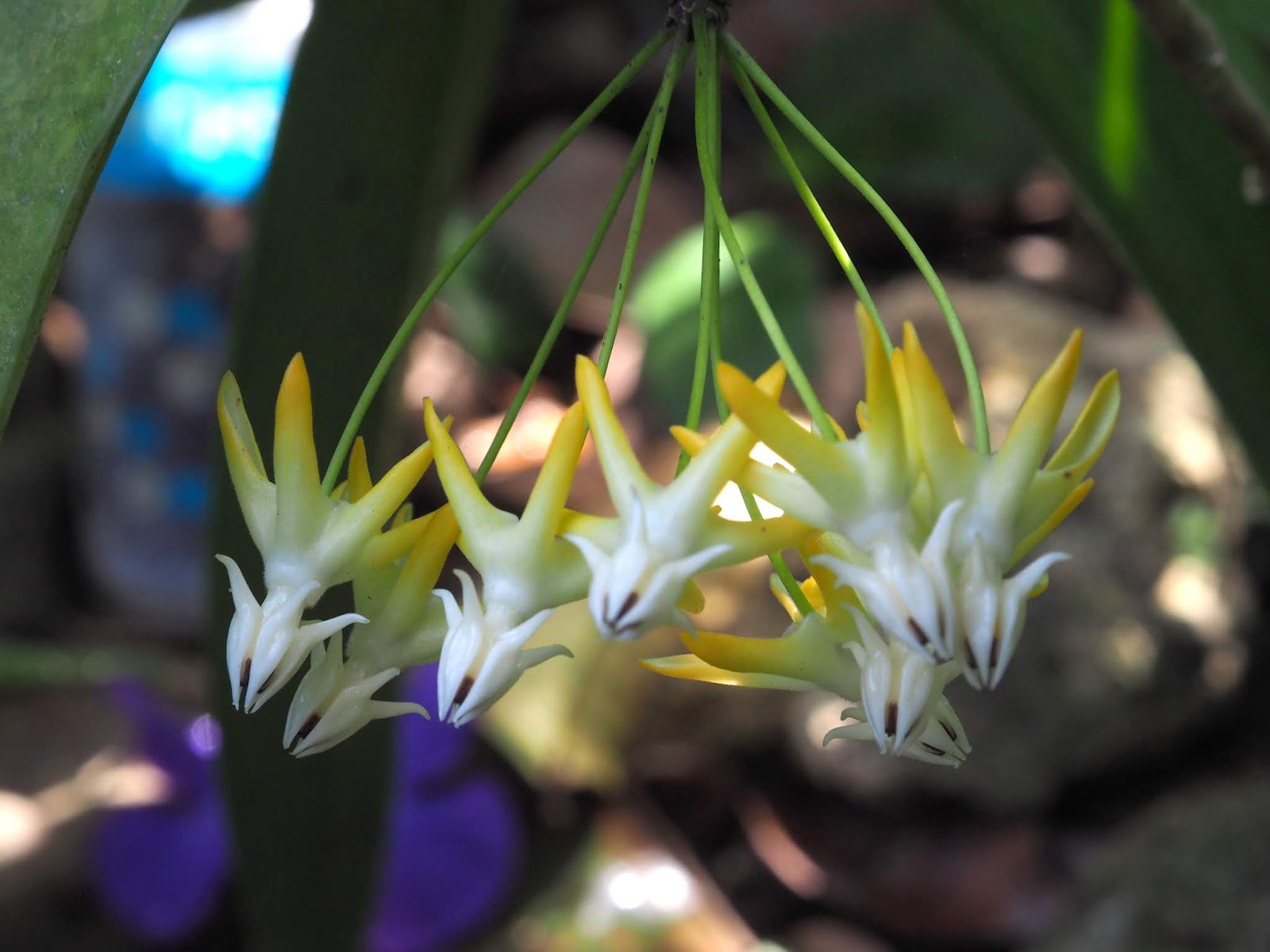


This Hoya pubicorolla ssp. anthracina is producing a few umbels, and they are all big and beautiful. Can you visualize it.

Hoya lacunosa is one of the small-umbelled hoyas, with also small leaves. But the size is compensated with the very lovely sweet scent, which everybody likes. Sometimes it has a lot of simultaneous umbels open at the same time.
Please bear with me in posting a lot of hoyas, i am a hoya addict, i confess! I always tell new hobbyists that it is addictive and contagious, so they must decide immediately before they are hooked. They are what use most of my time in the province during my weekends, the reason i always go home on Saturdays. I am sure you will understand. And i also warn you, if you are just starting to appreciate them, or starting to buy the first one!

The most loyal orchid in my garden, despite neglect it still produce flowers looking very elegant and standing high among the rest of them, a Vanda orchid. It really is the Queen of the Flowering Plants!

And another loyal and self-supporting orchid with very subtle, cool color is this vanda.

A lavender Pentas lanceolata is much loved by this Common Mormon. We have lots of butterflies, but this one never forgets to visit this pentas.


an introduced species, now relegated near the dump


This caladium variety is lovely too in that area with very thin topsoil. It covers the not so nice area there. I planted it there specifically because they produced so very big aand tall leaves when planted in richer soils. In this area they are shorter and narrower, producing more compact growth.

Look at the caladium when planted in rich soil. That big leaf at the left is more than 2 ft wide. Other leaves are following that size. Eventually i will get some corms and plant them too in nutrient deprived soils to produce more compact growth.

Thunbergia erecta

Caesalpinia pulcherrima, planted at the edge of the property, as a hedge. It is also host for the yellow butterflies.

Lastly, the Queen of the Night, Epiphyllum oxypetalum was not able to wait for me before it bloomed. Some bloomed in July which i did not see also. I always go home a few days after their big event. They open before midnight with strong fragrance, and they are already closed in the morning. Last week they opened on Thursday while this picture was taken Saturday. There still are a lot of them in many stems. A bit disappointing but we don't seem to have very good communication lines. Or i was not able to send a very exact instruction. The next blooming season will still be next year, that seems to be a long time.


