Showing posts with label Sanchezia. Show all posts

Monday, October 14, 2019

October 2019 Blooms

My last month's promise of posting more has not been fulfilled. I am so sorry for that. My consciousness just get more busy at the middle of the month for the Garden Bloggers Bloom Day.  The rest of the months i just do my usual garden chores, photo editing for FB and of course chatting with friends. Chatting with garden friends by creating articles have been shelved for new means of social media. But i am by habit still here for the monthly GBBD.

We are so thankful this year that no very strong typhoons are passing by our country's Area of Responsibility. Some were affected by the strong rains that come with typhoons at the Pacific, but at least they did not come directly to us, just like the previous years. So our plants and domestic crops are spared, and we have our household vegetable gardens giving us harvests. We cannot even finish the fruits of our few plants like okra, ampalaya, malunggay and sweet potato tops. My hoya plants are also not suffering setbacks due to strong winds from the strong typhoons.

Our area is not flat, so this area we put some blocks to contain the soil at the other side. I purposely did not put cement finish to that short wall because the green moss during the rainy season is a pleasant scene to see. That length is normally fully green this time of the year. I only planted a few Portulaca oleraceae for contrast.

Flowers of the orange Portulaca change hues from opening to senescense, which is only a full day.

 the reproductive parts of the cosmos flower

My red cosmos is still from a friend from the southern part of the country. I guess this color is common abroad in colder countries but not here. It could have been brought by friends from abroad, and i asked some seeds from her garden. The usual colors here in the country are the yellows and orange. But this red is truly a lovely addition to any garden, besides it is also loved by butterflies. 

the inflorescence is still lovely at the end of its blooming period

back shot of a cosmos flower

 the developing seeds are in those spindles

 We have a big plant of this Queen of the Night, Epiphyllum oxipetalum. The first big batch of flowers opened at the same time when i was not at home in August. I was so disappointed i did not see them opening simultaneously in one night. I can also just imagine the fragrance permeating the atmosphere that night, as they normally start producing scent at about 7 pm until the flowers close after midnight.  This month, as if to assuage my curiosity, a lone flower emerged. I waited till the flower fully opened just to take photos, and my waiting was rewarded.

 Queen of the Night fully open

 close-up of the reproductive parts that give its sweet scent

 Another plant that is plenty under some trees near the edge of our house is this Crossandra infundibuliformis. It also has a yellow form. They do not fully die during the dry season, because they have enlarged storage roots that keep them alive, and will emerge alive again come rainy months. That ensures its continuity nearing invasiveness. They are difficult to kill because of the dense storage roots.

 Another very prominent foliage plant in dry climates is this Sanchezia speciosa. They have tubular small flowers, but i prefer the beauty of their leaves. A dead spot in a garden can be enlivened by this plant. In mine, i planted it at the bottom of a jackfruit tree to cover the sickly trunk attacked by bark borers. That tree i used as a live trellis for the garlic vine. With this foliage the area looks lively and healthy despite the dying tree.

One of the most conspicuous flowering plant in October is this Hoya diversifolia, which i allowed to climb an almost dying lanzones tree. It has been there for 4 years and the most prolific flowering is now. I need to climb the roof of the first floor to get the pictures but i managed, i just go out of the window at the 2nd floor.  Some nodes are even bearing 2 or 3 umbels, and that is amazing for a hoya. I guess i am the only one in the country who has this kind of growth for this species. A full post will be done next time only for this hoya on the lanzones tree. 


Monday, May 12, 2014

Hirsute Beauties

Plants are usually equipped with hairs. They are mostly common in growing shoots, peduncles and flowers. These hairs are technically called trichomes. The description and patterns of these trichomes also have distinct names; e.g. hirsute - coarse hairs, hispid - bristly hairs, pilose - long, straight, soft or erect hairs, etc. These growths have mostly defense functions for the plant organ they arise from. Herbivores like larvae of insects will have physical difficulty to directly attack the plant parts with hairs. Some hairs even have chemical compositions that help deter invaders. This is the reason why most young shoots and buds have trichomes.

 Tubelike flower of Sanchezia speciosa. Both the style supporting the stigma, and the filament supporting the pollens are hairy. 

The anther is that portion above supported by the filament and contains the pollen. Even the anther is equipped with short dense hais that protects the pollen. The hairs can also trap predators.

The unoppened flower of the Sanchezia speciosa are borne on spikes


Sunday, August 5, 2012

Fate of some plants

Fate of the Sanchezia speciosa


           This is only planted here from cuttings for about two years now. We all love the pattern of its venation, with deep yellow veins on dark green background. It surely is a lovely plant in any area even with just the foliage. It also grows well despite drought and without any supplemental water during the dry season. Leaves just wilt at mid-day which eventually becomes turgid again in the evening. Every apical portion produced some tubular small flowers at the height of the dry season but is not really pretty. We tried to cut these flowering spikes to give way for the leaves.
 The branches spread sideways and downwards in the top photo, eventually covering the Ixora at its base. Another seedling that suffered from its embrace is the Song of India, which cannot cope with the Sanchezia's fast growth.
After the first heavy rains, i cut all the lower branches to expose the Song of India (Dracaena reflexa) and Ixora coccinea, which now has totally lost blooms and some leaves. The latter already suffered severely with only younger leaves showing health. I hope it will now recover. 
The above is the Ixora when it is not yet covered by the Sanchezia.

These are the pruned branches. They will just go to waste for food of the earthworms, fungus and bacteria. And you know what! My sister further fully cut all the top stems of the Sanchezia, to give way to better growths. Unfortunately, i forgot to take the photo of the bald plant, but it really looks pathetic at the moment. 

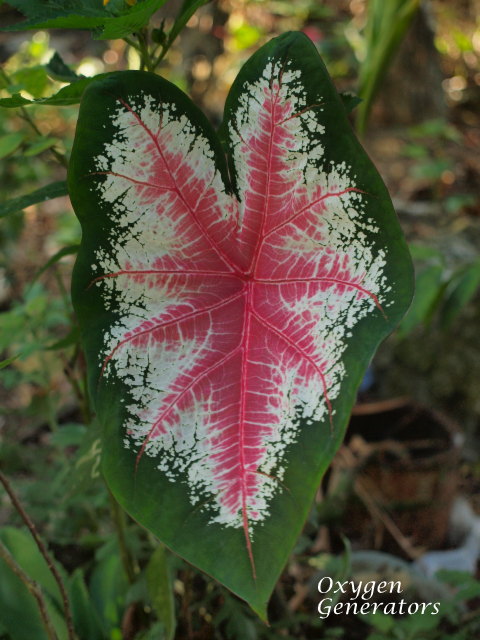
Fate of the caladiums, (Caladium bicolor)

       Caladiums favorably grow in our climate. They just become dormant underground during the dry season and produce leaves again when the rains come. We have them for many years now and some corms might have been carried by floods or chicken, as they can be seen around the property already.  Sometimes, i am thinking that winter is even an advantage to temperate gardeners. Their corms and bulbs will not persist outdoors during their winter season. If the gardener wants to preserve the plant, they have to keep it inside for protection. In our case in the tropics, they will just show up repeatedly through time, multiply itself anywhere, until people will not be enamored with them at all. 

One volunteer in the property that immediately showed gratefulness for the rains is the caladium. These are just the old traditional varieties, but beautiful nevertheless. They started as very small leaves and one corm, now i guess the corms are already big sending those big leaves, and also there are many corms growing in the clump.

 One plant produced a healthy flower. However, this plant is very near the pathway and should be removed.

 I also love this green and white variant. In fertile soils it produces big leaves and slender long petioles. I purposely planted it in an area with shallow top soil, so the petioles will be shorter. I am glad about the result as in above. 


 The variants above and below have single leaf each. It takes a while before the next leaves grow because this is in a shaded area. 


Another variant, whose petioles are shorter than the above colors. However, i only have one plant of this variant. I am still on the look-out for varieties available here. I am always envious of those i see in Meems garden at Hoe and Shovel in Florida.